ELLIPSE MAGAZINES
EDITION 01

01 / SCIENCE

The Hidden Danger Of A Rare Event

Solar eclipse
A solar eclipse transforms the familiar daytime sky.

There are few sights in nature more captivating than a solar eclipse. In the middle of the day, the sky begins to darken. Shadows become strangely sharp. The temperature can drop. Birds and animals may behave as if evening has suddenly arrived. And above it all, the Moon slowly moves across the face of the Sun.

It is almost impossible not to look.

That is exactly what makes a solar eclipse so dangerous.

The Sun is normally so overwhelmingly bright that most people instinctively avoid staring at it. During an eclipse, however, something changes. The Moon blocks much of the Sun's visible light, making the Sun appear less dazzling. It can create the illusion that the Sun has somehow become safe to look at.

It hasn't.

Even when the Sun appears partially covered, the remaining visible portion can still deliver enough concentrated radiation to injure the delicate tissues at the back of your eye. And one of the most unsettling things about this damage is that you might not realize it is happening until hours later.

So what actually happens when you stare at an eclipsed Sun?

Your Eyes Were Never Designed for This

Your eyes are extraordinary pieces of biological engineering. Light enters through the cornea, passes through the pupil and lens, and is focused onto the retina at the back of the eye.

The retina contains millions of light-sensitive cells that convert light into electrical signals. Those signals travel through the optic nerve to your brain, where they become the images you see.

But there is a limit to how much light these tissues can safely handle.

When you look at an ordinary object, light from that object reaches your eyes after being reflected or scattered in many directions. When you look directly at the Sun, you are looking at one of the most powerful sources of light in the sky.

Your eye's lens acts much like a magnifying glass, focusing incoming light onto a tiny area of the retina.

This is normally useful. It allows you to see incredibly fine details.

When the source of that light is the Sun, however, that focusing ability becomes a problem.

The energy can become concentrated onto a small region of the retina, potentially damaging the light-sensitive cells there.

The resulting injury is known as solar retinopathy.
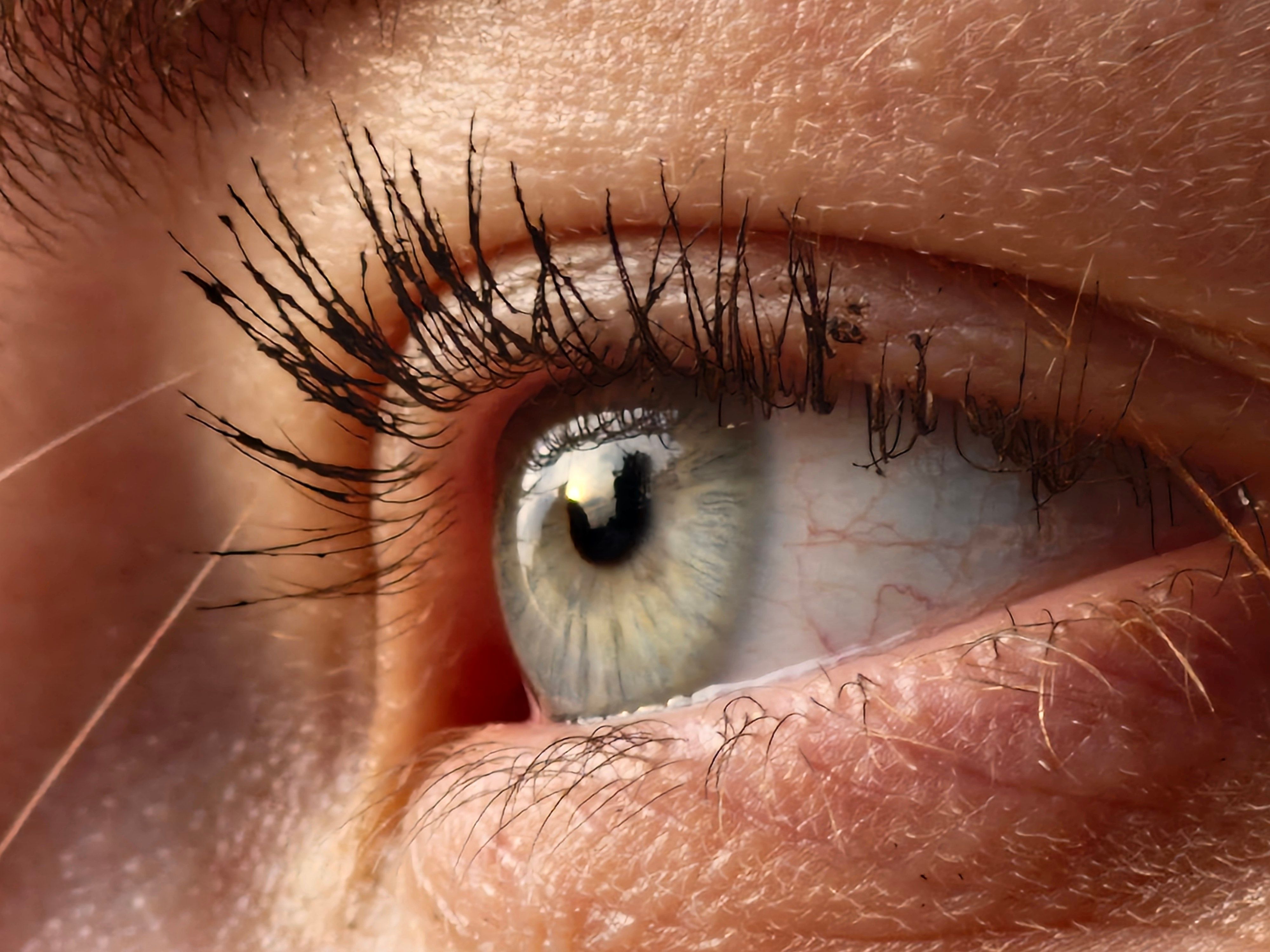
Human eye
The human eye focuses incoming light onto the retina.

But Isn't an Eclipse Less Bright?

This is one of the biggest misconceptions surrounding solar eclipses.

During a partial eclipse, the Moon covers part of the Sun. The Sun therefore appears dimmer.

But dimmer does not mean safe.

Imagine a powerful lamp partially covered by a piece of cardboard. The room may become darker, but staring directly into the exposed portion of the lamp does not suddenly become harmless.

The same basic idea applies to the Sun.

Even if 90 or 99 percent of the Sun is covered, the remaining visible portion is still the intensely bright solar surface. Your eyes can still receive enough energy to cause damage.

There is another problem: the eclipse itself makes people more likely to stare.

On an ordinary day, most people instinctively look away from the Sun because it is painfully bright. During an eclipse, curiosity takes over. Someone may glance upward for a few seconds, look again, and then keep watching.

The danger isn't always obvious.

The Scariest Part: It May Not Hurt

If you touch something extremely hot, your hand immediately tells you something is wrong.

Your eyes aren't nearly as good at warning you about retinal damage.

The retina does not have pain receptors in the same way that many other tissues do. As a result, staring at the Sun can cause injury without producing an immediate sensation of pain.

You might watch the eclipse and feel completely fine.

Then, several hours later, you could notice that something is wrong with your vision.

Straight lines may appear distorted. A blurry or dark spot might appear in the center of your vision. Colors can seem unusual. Reading may become difficult.

In serious cases, some of the damage can be permanent.

That delayed warning is one of the reasons solar viewing should never be treated casually.

What Actually Damages Your Eye?

Sunlight contains more than just the visible light that allows us to see.

It also contains ultraviolet and infrared radiation.

Different wavelengths interact with the eye in different ways. The cornea and lens absorb much of certain types of ultraviolet radiation, while the retina is particularly vulnerable to the intense visible and near-infrared light that can reach it.

When the eye focuses sunlight onto the retina, the energy can trigger both thermal and photochemical damage.

In simple terms, the light can cause chemical reactions and cellular injury in the retinal tissue.

And unlike the skin, which can often repair itself remarkably well after minor damage, the specialized cells of the retina do not simply regenerate whenever they are injured.

That is why prevention matters so much.

Why Regular Sunglasses Don't Work

You might think the obvious solution is simple:

"I'll just wear my darkest sunglasses."

Unfortunately, that isn't enough.

Regular sunglasses are designed to reduce the amount of ordinary sunlight reaching your eyes. They are useful for everyday outdoor conditions, but they are not designed for staring directly at the Sun.

Even very dark sunglasses can give you a false sense of security.

The correct way to directly view the Sun during an eclipse is to use properly manufactured solar viewing glasses or filters that meet the relevant safety standards.

These are not ordinary sunglasses.

They are specifically designed to reduce the Sun's visible, ultraviolet, and infrared radiation to safe levels for direct solar observation when used correctly.

And even with proper eclipse glasses, you should follow the manufacturer's instructions and inspect them for damage before use.
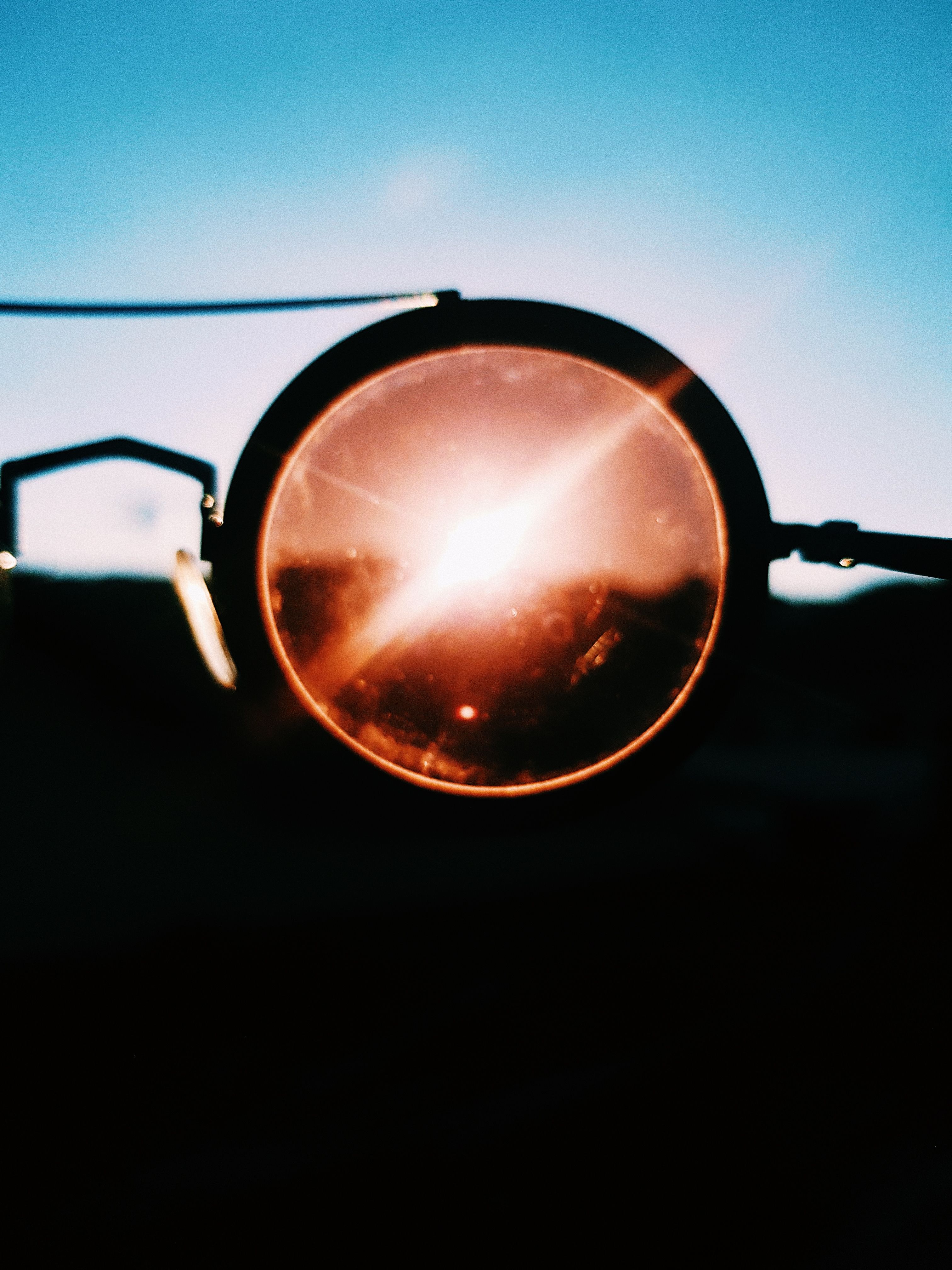
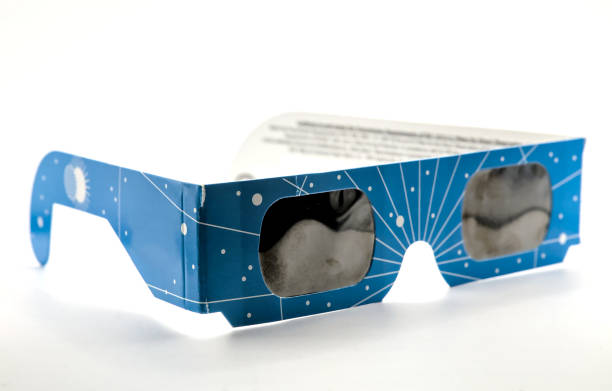
Solar eclipse glasses
Proper solar viewing glasses are designed specifically for observing the Sun.

What About Cameras and Binoculars?

This is where things become even more dangerous.

Your eyes naturally contain a focusing system. Optical devices such as binoculars, telescopes, and cameras can collect far more sunlight and concentrate it even more strongly.

Pointing an unfiltered telescope or pair of binoculars at the Sun can cause catastrophic eye injury almost instantly if someone looks through the eyepiece.

The same principle applies to cameras.

A camera sensor can also be damaged by direct sunlight, depending on the equipment and circumstances.

Safe solar observation therefore requires proper solar filters designed for the front of the optical equipment.

A filter placed incorrectly or using improvised materials can be extremely dangerous.

This is not an area where experimentation is worth the risk.
Solar optical equipment
Optical equipment requires properly designed solar filters for safe solar observation.

Then Why Do People Watch Eclipses at All?

Because eclipses are genuinely extraordinary.

A solar eclipse occurs when the Moon passes between Earth and the Sun and temporarily blocks some or all of the Sun's light from reaching parts of Earth.

The Moon is dramatically smaller than the Sun, but it also happens to be much closer to Earth. Because of this remarkable coincidence, the two objects can appear almost exactly the same size in our sky.

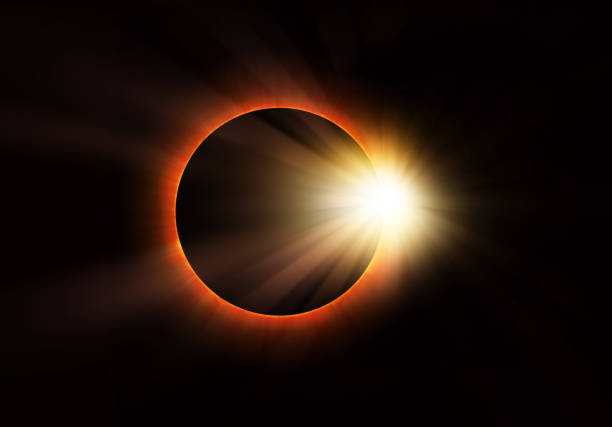
During a total solar eclipse, the Moon can completely cover the bright surface of the Sun.

For a brief period, the normally invisible outer atmosphere of the Sun—the corona—becomes visible.

The result is one of the most spectacular natural events humans can witness.

The answer isn't to avoid eclipses.

The answer is to watch them safely.
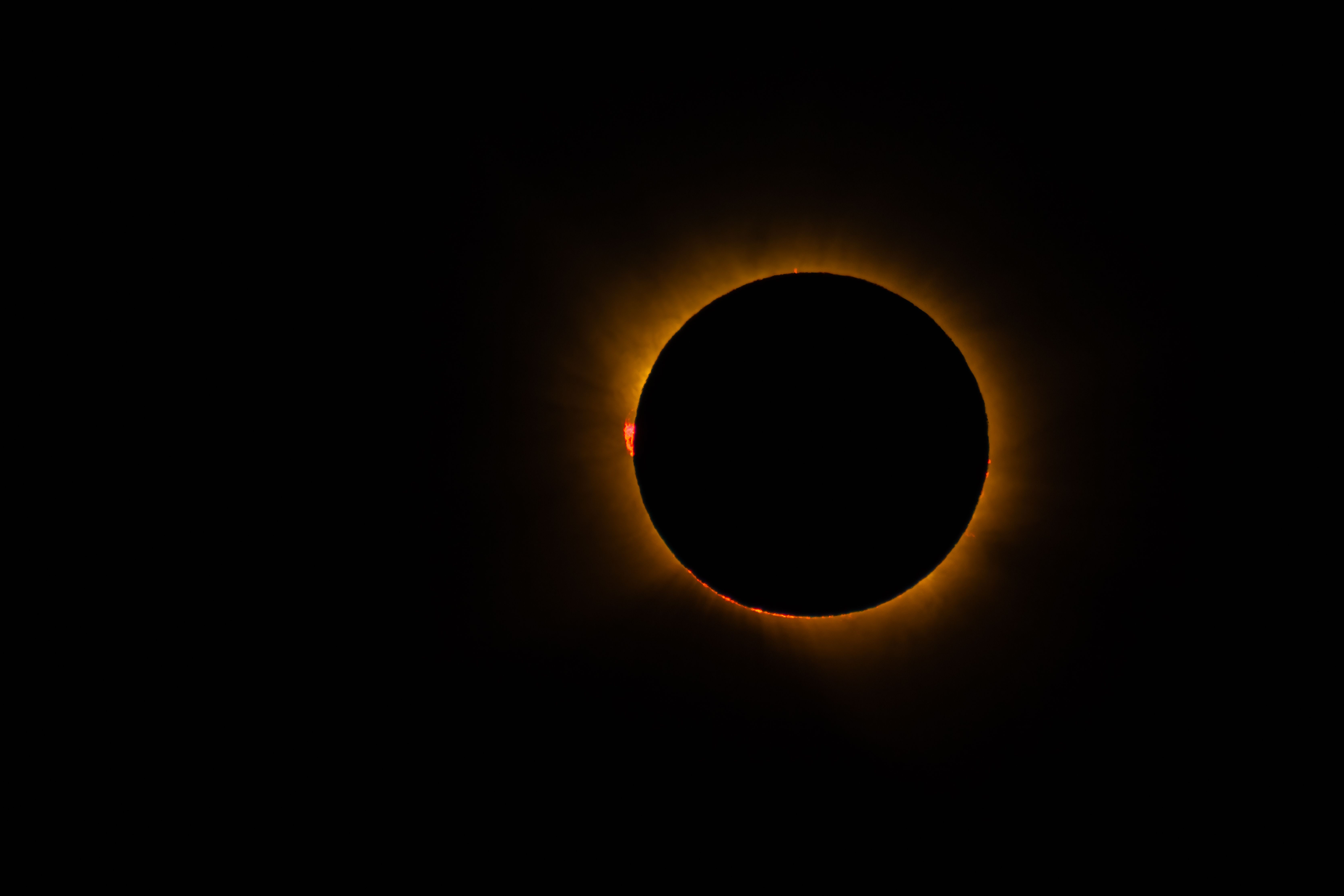
Total solar eclipse and solar corona
The solar corona becomes visible during totality.

The One Exception: Totality

There is an important detail that makes solar eclipses particularly interesting.

During the brief period of totality—when the Moon completely covers the bright surface of the Sun—it is generally safe to look at the eclipse directly with the naked eye.

But this applies only during totality.

The moment even a tiny portion of the bright solar surface becomes visible again, you need to protect your eyes.

That means eclipse glasses should be worn before and after totality and throughout a partial eclipse.

This distinction is extremely important because totality can end suddenly. The Sun can reappear as a brilliant point of light at the edge of the Moon, producing what is sometimes called the "diamond ring" effect.

It is beautiful.

It is also the moment to put your eclipse glasses back on.

How to Watch an Eclipse Safely

The safest approach is surprisingly simple.

Use certified solar viewing glasses or an appropriate solar filter specifically designed for direct observation of the Sun. Put them on before looking toward the Sun, and keep them on whenever any part of the bright solar surface is visible.

Never substitute ordinary sunglasses, photographic film, smoked glass, homemade filters, or other improvised materials.

If you're using a telescope, binoculars, or a camera, use a proper solar filter designed specifically for that equipment and installed correctly.

You can also watch an eclipse without looking at the Sun at all.

A simple pinhole projector can project an image of the partially eclipsed Sun onto another surface. You can also watch a professionally produced livestream or view the event through an astronomy organization or observatory.

You don't have to risk your eyesight to experience the eclipse.

The Strange Lesson of a Solar Eclipse

Perhaps the most fascinating thing about solar eclipses is that they demonstrate how easily our senses can fool us.

The Sun hasn't become weaker because the Moon is covering it.

Our eyes simply receive less visible light, making the Sun appear less threatening.

And that illusion can be dangerous.

A solar eclipse is a reminder that something doesn't have to look dangerous to be dangerous. The same Sun that gives us daylight, warmth, and the energy that supports life can also damage the very eyes we use to admire it.

Yet that shouldn't make eclipses frightening.

It should make us more curious.

With the right protection, you can stand beneath a darkening sky, watch the Moon swallow the Sun, see the world around you transform for a few extraordinary minutes, and witness one of the most beautiful events our planet has to offer.

Just don't stare at the Sun to see it.

Look through the right filter.

Because the safest way to witness something extraordinary is to make sure you can still see everything afterward.

↑ Back to Contents ↻ Read This Article Again

02 / HISTORY & TECHNOLOGY

The Ancient Computer That Shouldn't Exist

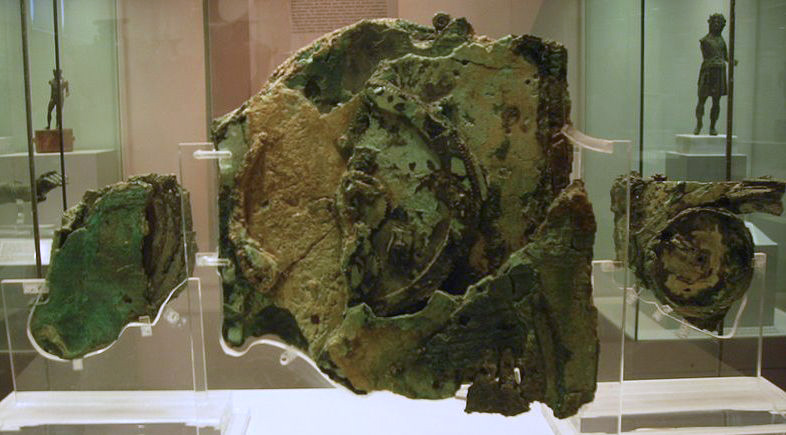
A fragment of the Antikythera mechanism.
A fragment of the Antikythera mechanism. Image: Marsyas (assumed), CC BY-SA 3.0, via Wikimedia Commons

In the year 1900, a group of Greek sponge divers descended into the Mediterranean Sea near a small, rocky island called Antikythera.

They were looking for sponges.

Instead, they found a shipwreck.

The wreck was filled with statues, pottery, jewellery, coins and other treasures that had been sitting on the seabed for roughly two thousand years. But among the ancient cargo was something far stranger: a corroded lump of bronze that looked almost worthless.

Nobody initially knew what it was.

Then, in 1902, something extraordinary was noticed inside it.

Gears.

Not one or two crude metal wheels, but an intricate collection of interlocking gears.

The object would eventually become known as the Antikythera Mechanism—and scientists would discover that it was an ancient astronomical calculator capable of tracking the movements of the Sun and Moon, predicting eclipses and representing complex astronomical cycles.

It had been built more than two thousand years ago.

And that is where the story gets strange.

Because nothing else from the ancient world quite prepared historians for a machine like this.

A sponge diver during the first underwater campaigns of the Antikythera shipwreck.
A sponge diver during the first underwater campaigns of the Antikythera shipwreck. Image: Unknown author, CC BY-SA 3.0, via Wikimedia Commons

A Machine at the Bottom of the Sea

The Antikythera Mechanism was recovered from a Roman-era shipwreck near the Greek island of Antikythera. The wreck itself was discovered around 1900–1901, and the mechanism was recognized as a geared device in 1902.

The ship had been carrying an extraordinary collection of objects, probably gathered from the Greek world before being transported elsewhere.

Among them was this mysterious machine.

But two thousand years underwater had not been kind to it.

The bronze had corroded. The wooden case had deteriorated. The mechanism had broken into fragments. What survived was only part of the original device.

For decades, researchers could see gears and inscriptions, but understanding how all those pieces fitted together was another matter entirely.

It was like discovering the remains of a modern computer after almost every circuit board had been smashed and then trying to figure out what it had once done.

Except this computer was ancient.

Fragments of the Antikythera Mechanism.
Fragments of the Antikythera Mechanism, including fragments A, B and C. Image: Therese Clutario, CC BY 2.0, via Wikimedia Commons

It Wasn't a Computer Like Yours

Calling the Antikythera Mechanism a "computer" can sound misleading.

It had no electricity.

There was no screen, processor or software.

Nobody was typing commands into it.

Instead, it was a mechanical analogue computer. Its calculations were performed physically, through carefully designed gears.

Turn a mechanism, and gears would rotate.

Those gears could represent mathematical relationships.

One rotation could drive another at a different speed. A gear could turn another gear a specific number of times. Through a carefully arranged network, the machine could represent astronomical cycles.

Modern researchers describe it as the oldest known mechanical calculator and the oldest known analogue computer. It was constructed around the second century BCE.

That alone would be remarkable.

But what those gears were calculating is even more impressive.

The Sky, Turned Into Gears

The ancient Greeks had spent centuries carefully observing the heavens.

They knew that the Sun and Moon followed predictable cycles. They tracked calendars, lunar months and astronomical phenomena. They also inherited and developed astronomical knowledge from earlier civilizations, including Babylon.

The Antikythera Mechanism transformed some of that mathematical knowledge into metal.

Its surviving components show that it could represent the cycles of the Sun and Moon, the phases of the Moon and calendars based on lunar and solar cycles. It also incorporated a system for predicting eclipses.

Think about what that means.

Someone living more than two thousand years ago could turn a handle on a machine and cause a collection of gears to model movements in the sky.

The heavens had been converted into machinery.

Antikythera mechanism - labelled
A labelled diagram of the Antikythera mechanism. Image: Lead holder, CC0, via Wikimedia Commons

The Moon Wasn't Moving in a Perfect Circle

One of the most remarkable details is hidden inside the mechanism's treatment of the Moon.

The Moon's apparent movement across the sky is not perfectly uniform. Its orbit is elliptical rather than a perfect circle, so its apparent speed changes.

Ancient Greek astronomers had mathematical theories to account for this irregular motion.

Researchers examining the Antikythera Mechanism found a mechanical realization of this idea in its gearing. The mechanism used an arrangement involving gears to reproduce the changing motion of the Moon.

This is where the machine stops looking like a simple calendar.

A calendar tells you what day it is.

The Antikythera Mechanism was attempting to model the behaviour of celestial bodies.

It was turning mathematical astronomy into physical motion.

It Could Predict Eclipses

Perhaps the most dramatic feature of the mechanism was its ability to predict eclipses.

On the back of the device was a spiral dial associated with the Saros cycle, a period of approximately 18 years and 11 days—223 lunar months—after which eclipse patterns repeat in a related way.

Researchers found inscriptions and markings associated with lunar and solar eclipses. The mechanism used this cycle to predict when eclipses could occur.

For people living in the ancient world, eclipses were not merely astronomical events.

They could be frightening.

The sudden disappearance of the Sun during the day was mysterious and, in many cultures, associated with omens.

Imagine having a machine that could tell you that such an event was coming.

Not because someone had guessed.

Not because a god had supposedly revealed it.

But because mathematical relationships had been encoded into bronze gears.

Back of Fragment A of the Antikythera mechanism.
The back of Fragment A of the Antikythera mechanism. Image: Logg Tandy, CC BY-SA 4.0, via Wikimedia Commons

The 19-Year Secret

Another dial on the mechanism represented the Metonic cycle.

The basic idea is beautifully simple.

A solar year and a lunar month don't fit neatly together. Twelve lunar months are shorter than a solar year, so lunar and solar calendars gradually drift apart.

But over approximately 19 solar years, 235 lunar months come remarkably close to lining up again.

This became known as the Metonic cycle.

The Antikythera Mechanism incorporated this 19-year cycle into its calendar system. Researchers discovered that its back dial was arranged as a five-turn spiral representing the 235 lunar months.

The machine therefore wasn't simply counting days.

It was dealing with the problem of reconciling different ways of measuring time.

An Ancient Instruction Manual

Perhaps one of the most fascinating parts of the mechanism isn't a gear at all.

It's the writing.

The surviving fragments contain thousands of tiny Greek characters engraved into the metal.

For researchers, those inscriptions were incredibly valuable.

They acted almost like an instruction manual.

Modern imaging techniques, including high-resolution surface scanning and X-ray tomography, allowed researchers to see details hidden inside the corroded fragments. In 2006, researchers published a major reconstruction that significantly increased the number of inscriptions they could read.

Suddenly, the machine wasn't just a pile of mysterious gears.

The surviving writing was telling researchers what some of those components were intended to represent.

And the more scientists learned, the stranger the machine became.

Detailed view of the Antikythera mechanism.
A detailed view of the Antikythera mechanism and its intricate gearing. Image: Juanxi, CC BY-SA 3.0, via Wikimedia Commons

The Missing Planets

The mechanism appears to have gone beyond the Sun and Moon.

Its inscriptions support the idea that it was intended to display the positions of planets, although much of the relevant planetary mechanism has been lost. Researchers have found references associated with planets including Venus and Mercury, and reconstructions suggest that planetary displays were part of the original design.

This is important because we don't actually possess the complete machine.

What survives is incomplete.

Some gears are missing.

Some components are damaged beyond recognition.

Some questions remain unanswered.

That means researchers have to distinguish between what the evidence proves, what it strongly suggests, and what remains a reconstruction.

And this is where the Antikythera Mechanism becomes even more interesting.

It isn't a solved puzzle.

It is an incomplete one.

So Who Built It?

This is one of the great mysteries.

We know the mechanism was made in the ancient Greek world, probably around the second century BCE. But exactly who designed it, where it was manufactured, and who commissioned it remain uncertain.

There have been proposals connecting its astronomical traditions with different parts of the Greek world.

One particularly interesting clue came from the calendar inscriptions.

Research published in 2008 identified the names of all twelve months on the Metonic calendar and found that they were unexpectedly of Corinthian origin. The researchers suggested that Corinthian colonies in northwestern Greece or Syracuse in Sicily were possible candidates for the mechanism's heritage.

But that does not mean we can confidently say, "This machine was built in Syracuse."

The evidence isn't that simple.

The honest answer is that its precise origin remains uncertain.

And that uncertainty is part of the mystery.

The Technology We Lost

Perhaps the most unsettling question isn't how the Antikythera Mechanism worked.

It's this:

Why don't we see more machines like it?

The mechanism is technically more complex than any known device for at least the following millennium.

That doesn't mean ancient people suddenly invented a machine that appeared from nowhere.

The mechanism was the product of generations of mathematical and astronomical knowledge. Ancient Greek scientists and engineers had sophisticated ideas about geometry, astronomy and mechanical devices.

But the surviving evidence suggests that something remarkable happened here.

A technological tradition capable of producing extremely sophisticated geared astronomical machinery existed in the ancient world, yet very few comparable devices survived.

Perhaps other machines were built and simply disappeared.

Bronze can be recycled.

Wood rots.

Ships sink.

Libraries burn.

Workshops disappear.

And sometimes an entire technological tradition can become nearly invisible to history.

The Antikythera Mechanism may therefore be more than a remarkable object.

It may be a glimpse of a much larger world of ancient technology that we have mostly lost.

A Computer From a Shipwreck

Today, the word computer makes us think of silicon chips, processors and enormous amounts of digital information.

The Antikythera Mechanism couldn't be more different.

It was made from bronze.

It was powered by a human hand.

It contained no electricity.

And yet, at its core, it did something remarkably familiar.

It took a mathematical model of the world and encoded that model into a machine.

Turn one part, and the machine translated that movement through a network of gears into information about the heavens.

That is computation.

Just not the kind we are used to seeing.

And perhaps that's why the Antikythera Mechanism feels so strangely modern.

The Machine We Still Don't Fully Understand

More than a century after its discovery, researchers continue to study the mechanism.

Modern technology has allowed scientists to see inside fragments that would have been almost impossible to understand a century ago. New reconstructions continue to test ideas about how its missing components may have worked.

But researchers are careful about the limits of the evidence.

We don't know exactly who built it.

We don't know precisely where it was made.

We don't know every function of every missing component.

And we certainly don't know whether it was a one-of-a-kind invention or the surviving example of a larger tradition.

What we do know is already extraordinary.

More than two thousand years ago, someone built a machine from bronze gears that could represent the movements and cycles of the heavens.

Then it disappeared beneath the sea.

For roughly two thousand years, it sat in darkness.

And when humans finally pulled it back into the light, we had to spend another century learning what it was.

The Antikythera Mechanism doesn't prove that ancient civilizations possessed technology identical to ours.

It proves something much more interesting:

They were capable of imagining machines in ways we may have underestimated.

And somewhere beneath the Mediterranean, there may still be other pieces of that lost story waiting to be found.

↑ Back to Contents ↻ Read This Article Again

03 / SCIENCE

The Hidden World Inside Antarctica

Ross Ice Shelf and Saunders Coast, Antarctica
Ross Ice Shelf and Saunders Coast, Antarctica. Image: Jacques Descloitres, MODIS Land Rapid Response Team, NASA/GSFC, Public domain, via Wikimedia Commons

Antarctica looks almost completely lifeless from a distance. A continent covered by enormous ice sheets, surrounded by freezing seas and battered by powerful winds hardly seems like a place where microscopic life could thrive. Yet beneath and within that frozen landscape is an ecosystem far more complicated than the white surface suggests.

Bacteria live in Antarctic soils. Microorganisms survive inside tiny pockets of liquid water in ice and snow. Algae grow in places where sunlight reaches the surface. Beneath ice shelves, in complete darkness, microbial communities obtain energy through chemical reactions rather than sunlight. And wherever there are living microorganisms, there is another form of life, or depending on how one defines life, waiting to be found: viruses.

Scientists have now detected a remarkable diversity of viruses in Antarctic environments. Some are associated with microbial communities living in glacier melt holes and lakes. Others occur in Antarctic sea ice and beneath enormous floating ice shelves. Many of their genetic sequences do not closely match anything previously recorded.

That discovery changes the way we think about Antarctica. The ice is not simply a frozen desert. It can be part of a functioning microscopic ecosystem.

A virus does not need a human to survive

When people hear the word virus, they often think about influenza, COVID-19 or other diseases. But the overwhelming majority of viruses found in natural environments are not human pathogens.

Many viruses infect bacteria. These are called bacteriophages, or simply phages. Others infect archaea, algae and other microscopic organisms.

This distinction is particularly important in Antarctica.

The viruses scientists have discovered there are generally being studied as components of microbial ecosystems, not as mysterious human diseases waiting to emerge. Their hosts may be bacteria or archaea adapted to extremely cold, dark and nutrient-poor conditions.

In other words, finding a virus in Antarctic ice does not automatically mean finding a threat to humans.

In fact, viruses are a normal part of ecosystems. By infecting microorganisms, they can influence which species become abundant and which decline. When viruses kill microbial cells, the contents of those cells can return to the environment, making nutrients available to other organisms.

In Antarctica, where nutrients can be scarce and microbial communities live under extreme conditions, that relationship becomes especially interesting.

Viruses have been found in Antarctic ice-associated habitats

One of the clearest examples comes from cryoconite holes, small meltwater-filled holes that form on the surface of glaciers.

Although they may look insignificant, these tiny pools can become miniature ecosystems. Dust and other particles accumulate on glacier surfaces, absorb sunlight and create localized melting. Water collects around the particles, producing a small habitat where microorganisms can live.

Researchers studying cryoconite holes in Antarctica identified numerous viral genomes, including viruses belonging to the Microviridae and previously unclassified groups of small single-stranded DNA viruses. The viral communities varied between locations and broadly followed differences in the microbial communities living there.

This is an important clue. The viruses were not simply random pieces of genetic material scattered across the ice. Their distribution was associated with the microorganisms inhabiting these microscopic environments.

That suggests an active ecological relationship between viruses and their hosts.

Antarctica therefore has something resembling a microscopic version of the familiar food webs found elsewhere on Earth, except that instead of forests, insects and birds, much of the action takes place among bacteria, archaea, algae and viruses.

An even stranger ecosystem exists beneath the ice

The most extraordinary discoveries are not necessarily inside solid glacier ice. They are beneath Antarctica's floating ice shelves.

An ice shelf is a huge slab of ice extending from the Antarctic ice sheet over the ocean. The water underneath can remain in darkness beneath hundreds of metres of ice.

It sounds like one of the least hospitable places imaginable.

Yet it contains life.

In a 2023 study published in Nature Communications, researchers examined genetic data from beneath the Ross Ice Shelf, the largest Antarctic ice shelf. Their analysis identified 607 bona fide viral genome fragments from the subshelf environment. Most belonged to groups of viruses associated with double-stranded DNA, while smaller numbers belonged to other viral groups, including single-stranded DNA and RNA viruses.

The remarkable part was not simply the number.

Many of these viruses appeared to be unlike viruses already known from other environments. Approximately half of the predicted viral genes showed no similarity to genes in existing viral databases, suggesting that the Antarctic subshelf environment contains a large amount of previously unexplored viral diversity.

Some of the viruses also showed evidence of activity.

Researchers found viral genetic signals associated with microorganisms involved in nitrogen and sulfur cycling. The viruses appeared capable of infecting organisms such as Nitrosopumilus and Thioglobus, microorganisms that can play important roles in the chemistry of these dark ecosystems.

So beneath hundreds of metres of Antarctic ice, where sunlight cannot reach, viruses may be influencing the metabolism and survival of microorganisms.

The frozen continent is far from biologically silent.

How can anything live without sunlight?

Sunlight is the foundation of most ecosystems we encounter. Plants and algae capture solar energy through photosynthesis, and animals ultimately depend on that productivity.

But life has another option: chemosynthesis.

Some microorganisms obtain energy by carrying out chemical reactions involving substances such as ammonia, sulfur compounds and other inorganic molecules.

This appears to be important beneath Antarctic ice shelves.

The 2023 Ross Ice Shelf study found viruses associated with microorganisms involved in ammonium and sulfur oxidation. Some of the viruses also carried genes that could potentially influence how their hosts obtain or process nitrogen, sulfur and phosphorus.

This means viruses may do more than simply kill cells.

They can sometimes carry genes that alter the metabolism of their hosts during infection. Scientists call these auxiliary metabolic genes.

The exact ecological effects of these genes in Antarctic environments still need further investigation. But their presence suggests that viruses could participate in the chemical processes that keep these hidden ecosystems functioning.

The idea is surprisingly profound: even in a permanently dark environment beneath an enormous ice shelf, viruses can become part of the machinery that moves nutrients through the ecosystem.

What about ancient viruses frozen in Antarctic ice?

This is where the story becomes more complicated.

Glaciers and ice sheets can preserve biological material for extremely long periods. Snow falling onto a glacier can trap microorganisms, fragments of DNA and other particles. As more snow accumulates, pressure gradually transforms it into ice. Deep ice can therefore preserve a record of past environments.

Scientists have successfully recovered microorganisms and genetic material from ancient Antarctic ice cores.

For example, researchers have studied microbial material preserved in ice cores from Antarctica, including samples tens of thousands of years old. Such studies demonstrate that Antarctic ice can act as a historical archive of microorganisms and atmospheric material.

But this does not mean that scientists have discovered ancient Antarctic human viruses waiting to awaken.

That distinction matters.

Some of the most impressive discoveries about ancient viruses in glacier ice actually come from outside Antarctica. In particular, researchers studying the Guliya ice cap on the Tibetan Plateau recovered viral genomes from ice spanning more than 41,000 years. A 2024 Nature Geoscience study reconstructed approximately 1,705 species-level viral operational taxonomic units from nine different time periods.

The study showed that viral communities preserved in the glacier differed between colder and warmer periods. It provided evidence that ancient glaciers can preserve a record of viral communities and their relationships with changing climate conditions.

That is fascinating, but Guliya is in Tibet, not Antarctica.

It would therefore be inaccurate to take those findings and claim that scientists have discovered 40,000-year-old human viruses frozen throughout Antarctic ice.

The real Antarctic story is already fascinating enough.

A frozen archive of Earth's past

Ice cores are among the most valuable scientific records on the planet.

A deep ice core can contain layers deposited thousands or even hundreds of thousands of years ago. Scientists use them to investigate past temperatures, atmospheric gases, volcanic eruptions, dust and other environmental changes.

Microorganisms and biological molecules can become trapped in those layers as well.

This raises an intriguing possibility: Antarctic ice may preserve not only a record of the physical climate but also fragments of ancient microbial ecosystems.

However, studying viruses in ancient ice is technically difficult.

The amount of biological material can be extremely small. Modern contamination is a major concern. A single stray piece of DNA introduced during drilling or laboratory processing could potentially be mistaken for ancient material.

That is why researchers working with glacier ice have developed extremely careful decontamination and sequencing procedures. Studies of ancient glacier ice outside Antarctica have demonstrated how important these precautions are when attempting to identify authentic viral sequences.

Scientists therefore have to ask a deceptively simple question:

Did this genetic sequence really come from the ancient ice, or did it arrive there during sampling and laboratory work?

Answering that question is one of the hardest parts of ancient microbial research.

Antarctica's viral world is still largely unexplored

The biggest surprise may be how little we actually know.

A 2025 review of microorganisms associated with glaciers in the South Shetland Islands noted that relatively few studies have examined viral diversity directly in Antarctic glacier ice. Much more research has focused on Antarctic lakes, seawater beneath ice shelves and other environments.

This means the statement that Antarctica contains “thousands of unknown viruses” needs context.

There certainly is enormous viral diversity in Antarctic ecosystems, and researchers continue to discover viruses whose genomes are difficult to match with existing databases. Antarctic rock-associated microbial communities alone have produced a predicted catalogue containing more than 75,000 viral operational taxonomic units.

But a predicted viral sequence is not necessarily a completely characterized virus. Scientists often reconstruct viral genomes from environmental DNA or RNA without ever seeing the virus under a microscope or growing it in a laboratory.

Modern environmental virology therefore works much like exploring a giant library in which most of the books have never been catalogued.

Researchers can find genetic fragments and reconstruct genomes, but many of the organisms they represent remain biologically mysterious.

Could melting ice release viruses?

This is perhaps the question that attracts the most attention.

As glaciers and ice sheets melt, material that has been trapped in ice can eventually enter surrounding environments. Scientists are interested in whether microorganisms and viruses preserved in frozen environments could become active again.

But there is an enormous difference between possibility and demonstrated danger.

The presence of viral genetic material in ancient ice does not prove that the virus is still infectious. Freezing can preserve biological molecules, but damage accumulates over time. Viral infectivity depends on many factors, including whether the viral particle remains structurally intact and whether a suitable host is available.

There is also no scientific basis for assuming that every ancient virus is capable of infecting humans.

Most viruses are highly specialized for particular hosts. A virus that infects an Antarctic bacterium is not automatically capable of infecting a person.

That is why scientists are more interested in understanding these viruses as components of ecosystems than in treating every discovery as an impending pandemic.

A microscopic frontier

Perhaps the most interesting lesson from Antarctic virology is that the continent challenges our definition of a “habitable” environment.

We tend to imagine life requiring comfortable temperatures, abundant water and sunlight.

Antarctica demonstrates otherwise.

Life can persist in tiny pockets of liquid water, beneath ice, inside rocks, in hypersaline environments and in complete darkness. Viruses are part of many of these microbial communities.

The more scientists look, the more unfamiliar the Antarctic viral world becomes.

The 2024 study of Antarctic marine viruses found that roughly 75 percent of the viral diversity identified in the Southern Ocean had not previously been detected in other oceanic regions examined by the researchers.

More recently, research into polar sea ice has continued to reveal diverse viral populations and possible roles in microbial metabolism, reinforcing the idea that frozen marine environments are not biologically empty.

The Antarctic environment may therefore represent one of Earth's largest unexplored reservoirs of viral diversity, not necessarily because it is filled with dangerous ancient pathogens, but because its microbial ecosystems have evolved under conditions that are very different from those found in most studied environments.

The real mystery is not what is hiding in the ice

The popular image of Antarctic viruses is dramatic: ancient pathogens trapped for thousands of years, waiting for melting ice to release them.

The scientific reality is quieter, and arguably much more fascinating.

Antarctica contains viruses because Antarctica contains life.

Some of those viruses infect bacteria. Some infect archaea or other microorganisms. Some appear to be active beneath enormous ice shelves. Others exist in meltwater holes, lakes, soils and sea ice. Many have genetic features that scientists have never encountered before.

And while Antarctic ice can preserve biological material from the past, researchers are still determining exactly how much ancient viral diversity is preserved in the continent's deepest ice and how much of it remains biologically intact.

The ice is therefore not a sealed tomb filled with monsters from Earth's past.

It is something more interesting: a living laboratory and a historical archive at the same time.

Every new sample gives scientists another glimpse into microorganisms that have adapted to some of the harshest conditions on Earth. Their viruses may help control microbial populations, recycle nutrients and shape ecosystems hidden from sunlight.

There is still an enormous amount left to discover.

Far beneath Antarctica's white surface, in darkness and freezing temperatures, an invisible biological world continues its work.

And in that world, some of the smallest entities on Earth may be among the most abundant, and the least understood.

↑ Back to Contents ↻ Read This Article Again

04 / PSYCHOLOGY

Why Do We Love Antagonists?

The Psychology Behind Our Attraction to the Dark Side

Think about your favourite character from a movie, book or television series.

There is a good chance that character is not always the protagonist.

Sometimes, it is the antagonist who steals every scene. The character who is supposed to stand in the protagonist's way becomes the one we cannot stop watching. We may disagree with their actions, dislike what they are doing, and still find ourselves more interested in them than the character who is supposed to be on the "right" side.

It is an interesting contradiction.

Stories traditionally give us a protagonist to follow and an antagonist to oppose. The protagonist usually represents the main perspective of the story, while the antagonist creates conflict and prevents them from achieving their goals.

Yet audiences often become deeply attached to antagonists.

Think about characters such as Darth Vader, the Joker, Hannibal Lecter or Magneto. They are antagonists, but their popularity has gone far beyond their original roles in their stories.

Why?

The answer is not simply that people secretly want to be evil. Psychology gives us a much more complicated explanation.

We do not always like the antagonist. We like what the antagonist brings to the story.

One reason antagonists can become fascinating is that they create uncertainty.

A traditional protagonist usually has certain limits. They have rules they try to follow, people they care about and consequences they are unwilling to accept.

An antagonist may not have the same restrictions.

They can lie when the protagonist cannot. They can break rules. They can make decisions that other characters would never consider.

That unpredictability makes them interesting.

Research into fictional characters has found that audiences can become positively engaged with characters who behave immorally. Researchers have studied this through concepts including identification, sympathy, fascination and moral disengagement.

In simple terms, we can enjoy following a character without approving of everything that character does.

That distinction is important.

You can think a character is terrible and still think they are an incredible character.

The antagonist does not have to be a good person

When people discuss the popularity of antagonists, there is often an assumption that audiences must somehow believe these characters are morally good.

They do not.

A person can understand why a character behaves a certain way without agreeing with them.

Imagine an antagonist who grew up in an abusive environment and became obsessed with controlling everyone around them. You might understand where the behaviour came from. You might even feel sorry for the character at certain moments.

That does not mean you approve of their actions.

Psychologists studying fictional characters distinguish between several different forms of engagement. Liking, sympathy, empathy, identification and fascination are not exactly the same thing.

You can be fascinated by a character without wanting to become like them.

This helps explain why some of the most memorable antagonists are not simply evil for no reason. They have motives, weaknesses, relationships and contradictions.

The more we understand them, the more complicated our reaction becomes.

We like characters who are difficult to understand

A completely predictable antagonist is usually boring.

If the audience knows exactly what the character will do every time they appear, there is little mystery left.

The more interesting antagonists often force us to ask questions.

Why are they doing this?

Do they actually believe they are right?

Would they have become different people under different circumstances?

Do they care about anyone?

Are they capable of changing?

These questions keep the character in our minds.

A 2025 review examining the psychology and neuroscience of fictional antagonists described antagonists as characters who can create moral and psychological complexity because they challenge the audience's normal expectations about right and wrong.

That complexity matters.

A protagonist may make us feel admiration. A complicated antagonist can make us feel several things at once.

Fear.

Curiosity.

Disgust.

Sympathy.

Confusion.

Even admiration.

When several emotions compete at the same time, we tend to pay attention.

The strange power of identification

One of the strongest explanations for our attachment to fictional characters is identification.

When we identify with a character, we temporarily imagine the world from their perspective. We do not literally become that character, but we can begin to experience the story through their goals, problems and emotions.

This can happen with morally questionable characters too.

An antagonist might want revenge after losing someone they loved. We may not agree with the violent way they pursue revenge, but the basic emotion behind it is understandable.

That creates an unusual situation.

We can reject the character's actions while understanding the emotion that produced them.

Research on dark fictional characters has specifically connected liking for these characters with identification and moral disengagement.

This is one reason an antagonist with understandable motivations can feel more interesting than one whose only explanation is "because they are evil."

Moral disengagement lets us explore darker stories

There is another psychological mechanism at work.

When we watch fiction, we know it is fiction.

That gives us psychological distance from what we are seeing.

If a fictional character commits a terrible act, we do not have to respond exactly as we would if we witnessed the same thing happening in real life. We can temporarily accept the story's world and follow the character without treating our enjoyment as a reflection of our real-world morality.

Researchers call one part of this process moral disengagement.

It can involve mentally justifying a character's actions, focusing on their circumstances or temporarily setting aside the moral standards we would normally apply.

Research involving morally ambiguous protagonists has found relationships between moral disengagement, identification with characters, liking and enjoyment of stories.

This does not mean people lose their morality when watching movies.

It means fiction gives us a safe space to explore situations that would be disturbing or unacceptable in reality.

That is one reason stories can allow us to examine darker forms of human behaviour without actually carrying them out ourselves.

Sometimes the antagonist has what the protagonist lacks

There is another reason antagonists can steal attention from protagonists.

They are often written as extremely capable.

Think about the classic mastermind antagonist. They have a plan. They anticipate the protagonist's moves. They manipulate people. They remain calm while everyone else is panicking.

The audience may hate what the antagonist is doing, but still recognise their intelligence or competence.

This creates an interesting psychological split.

"I hate this person."

"How did they think of that?"

Those two reactions can exist at the same time.

Researchers have proposed that agency, autonomy, competence and status can influence people's attraction to certain fictional characters. However, research does not support the idea that these qualities alone explain antagonist popularity. In a large study, darker personality traits were stronger predictors of positive engagement with fictional antagonists than the researchers' competing measure of agentic values.

So the brilliant antagonist is interesting, but brilliance alone does not explain everything.

The "dark side" explanation is popular, but incomplete

You may have heard the idea that we love antagonists because they represent the dark side of ourselves.

It is an appealing explanation.

Psychologist Carl Jung's concept of the Shadow is often used in popular discussions of fascination with antagonists. The Shadow refers broadly to aspects of the personality that a person does not consciously accept or identify with.

Some discussions of fictional antagonists use this idea to suggest that antagonists represent impulses we normally suppress.

But this should not be presented as a proven explanation for why everyone likes antagonists.

Modern psychological research gives us stronger evidence for several other mechanisms, including identification, moral disengagement and individual personality differences.

There is no scientific evidence that every person who enjoys watching an antagonist is secretly expressing a repressed desire to behave like that character.

Sometimes an antagonist is simply well written.

And personality really does matter

Still, personality cannot be ignored.

One particularly interesting study published in Poetics examined 1,805 North American participants and looked at whether personality characteristics were related to positive engagement with fictional antagonists.

The researchers examined the three traits commonly known as the Dark Triad: narcissism, Machiavellianism and psychopathy.

The study found that higher levels of these traits were associated with greater reported enjoyment, identification, fascination and empathy toward antagonistic characters.

That sounds dramatic, but it needs to be interpreted carefully.

It does not mean that people who enjoy antagonists are psychopaths or narcissists.

The Dark Triad traits exist on dimensions, and a person's score on a personality measure does not automatically mean they have a personality disorder.

More importantly, the study found an association, not proof that having a darker personality causes someone to love antagonists.

Other research has also found relationships between liking dark fictional characters and Machiavellianism, along with differences in moral concerns and people's willingness to engage with immoral fictional worlds.

So personality appears to be one piece of the puzzle, not the entire puzzle.

Why morally grey characters are so popular

There is another character type that sits between the protagonist and antagonist.

The antihero.

Unlike a traditional protagonist, an antihero may lie, steal, manipulate people or use violence. But unlike a traditional antagonist, the story often places us on their side.

This creates a powerful psychological effect.

We know the character is doing things that are morally questionable, but we also understand their goals.

Walter White is a good example of how this works. At the beginning of Breaking Bad, audiences can understand his desperation and his desire to provide for his family. As his decisions become increasingly harmful, the relationship between the audience and the character becomes more complicated.

The question changes from "Is this person good?" to "How far can I continue to understand this person?"

That is a much more interesting question for a story.

Research on dark fictional characters includes not only antagonists but also morally ambiguous protagonists and antiheroes because these characters create similar psychological challenges for audiences.

Modern audiences often do not need a character to be completely good.

They need the character to be believable.

We are curious about people who break the rules

There is also something naturally attention-grabbing about rule breakers.

A character who follows every social rule rarely creates much mystery.

A character who ignores those rules can make us wonder what they will do next.

This does not mean humans naturally admire antisocial behaviour. In real life, harmful behaviour can produce fear, rejection and avoidance.

Fiction changes the situation.

We can watch a dangerous character from a safe distance.

We can observe their decisions without being personally threatened.

That distance allows curiosity to take over.

An antagonist can therefore become a kind of psychological experiment for the audience.

What happens if someone stops caring about the rules?

What happens if revenge becomes more important than morality?

What happens when intelligence is used for selfish purposes?

What happens when someone believes that their terrible actions are justified?

Fiction lets us explore those questions without having to experience their real-world consequences.

Fear can make a character memorable

Not all antagonist attraction is about liking.

Sometimes fear itself creates fascination.

A frightening character demands attention because we want to know what they will do next. Fiction can use the same attention mechanisms that make potential threats difficult to ignore in everyday life.

A well-written antagonist can therefore become the centre of a story even when the audience does not sympathise with them.

This is why some antagonists remain memorable long after the plot has been forgotten.

The audience may not want the antagonist to win.

They simply want to see what happens next.

The best antagonists make us question ourselves

Perhaps the most effective antagonists are not the ones who make us say, "I want to be like them."

They are the ones who make us think, "I understand why they did that."

That is a much more uncomfortable feeling.

An antagonist who is completely different from us is easy to reject.

An antagonist who shares some ordinary human emotion with us is harder to dismiss.

They might want respect.

They might fear losing someone.

They might feel humiliated.

They might want revenge.

They might believe they are protecting their family.

The emotion can be familiar even when the behaviour is horrifying.

That is where great antagonists become psychologically interesting.

They remind us that human behaviour is rarely as simple as good people doing good things and bad people doing bad things.

So, why do we love antagonists?

There is no single answer.

Some people are attracted to the intelligence and competence of an antagonist. Some become emotionally attached because they understand the character's motives. Some enjoy the unpredictability. Some identify with particular aspects of the character. Others simply enjoy watching a complicated character make increasingly extreme decisions.

Personality differences also play a role. Research has found associations between darker personality traits and positive engagement with fictional antagonists, but that does not mean antagonist fans are secretly dangerous or immoral.

And sometimes the explanation is much simpler.

The antagonist is just more interesting.

A protagonist who always knows right from wrong can be satisfying. An antagonist who makes us question where right and wrong begin can stay in our heads for years.

That may be the real power of a great antagonist.

We do not necessarily love antagonists because we want evil to win.

We love them because they allow us to explore parts of human behaviour that ordinary protagonists cannot.

They let us look at ambition without limits, intelligence without conscience, revenge without restraint and fear without pretending everything will be fine.

And perhaps that is why, when the credits finally roll, we sometimes remember the antagonist more clearly than the protagonist.

The protagonist may have carried the story.

The antagonist may have made us think about it.

↑ Back to Contents ↻ Read This Article Again

05 / SCIENCE

How Is One Second Really One Second?

Atomic clock
An atomic clock at the National Institute of Standards and Technology. Image: National Institute of Standards and Technology, Public domain, via Wikimedia Commons

The ordinary second has an extraordinary definition

Look at a clock.

Wait for the second hand to move from one mark to the next.

That is one second.

At least, that is how we usually think about it.

But there is a strange question hiding behind something so ordinary: how do we know that a second is actually a second?

A clock cannot simply be told what a second is. A clock needs something stable to count. For thousands of years, humans used the sky. The movement of the Sun gave us days, and the movement of the Earth helped us divide those days into smaller units.

That worked reasonably well until scientists needed much greater precision.

The Earth, it turns out, is not a perfect clock.

Its rotation changes slightly.

So scientists eventually stopped using the Earth itself as the ultimate reference for a second. Instead, they turned to something much smaller and far more predictable: an atom.

Today, the international definition of the second is based on cesium-133, a particular isotope of the element cesium.

And the number involved is enormous:

9,192,631,770.

That is the number of cycles of a particular electromagnetic transition in a cesium-133 atom that defines one second.

But why cesium?

And what exactly is a "cycle" inside an atom?

The second was once based on the Sun

The idea of a second is much older than atomic clocks.

Historically, the second was connected to the length of a day. Before 1960, the official definition was essentially 1/86,400 of the mean solar day.

That sounds perfectly reasonable.

There are 24 hours in a day.

Each hour has 60 minutes.

Each minute has 60 seconds.

So:

24 × 60 × 60 = 86,400.

One second was therefore one 86,400th of the average solar day.

The problem was that the Earth's rotation is not perfectly constant.

The length of a day changes by small amounts because of interactions between the Earth and Moon, movements within the Earth's atmosphere and oceans, and other effects. The changes are tiny, but modern science and technology eventually became sensitive enough that they mattered.

Scientists needed something more stable.

In 1960, the definition of the second was changed to use a reference based on Earth's orbit around the Sun. But even that was eventually replaced.

By the 1950s, researchers had already demonstrated that atoms could provide a much more precise reference.

In 1967, the international scientific community officially redefined the second using cesium-133.

That decision changed timekeeping forever.

So what is special about cesium-133?

To understand the definition of a second, we have to go inside an atom.

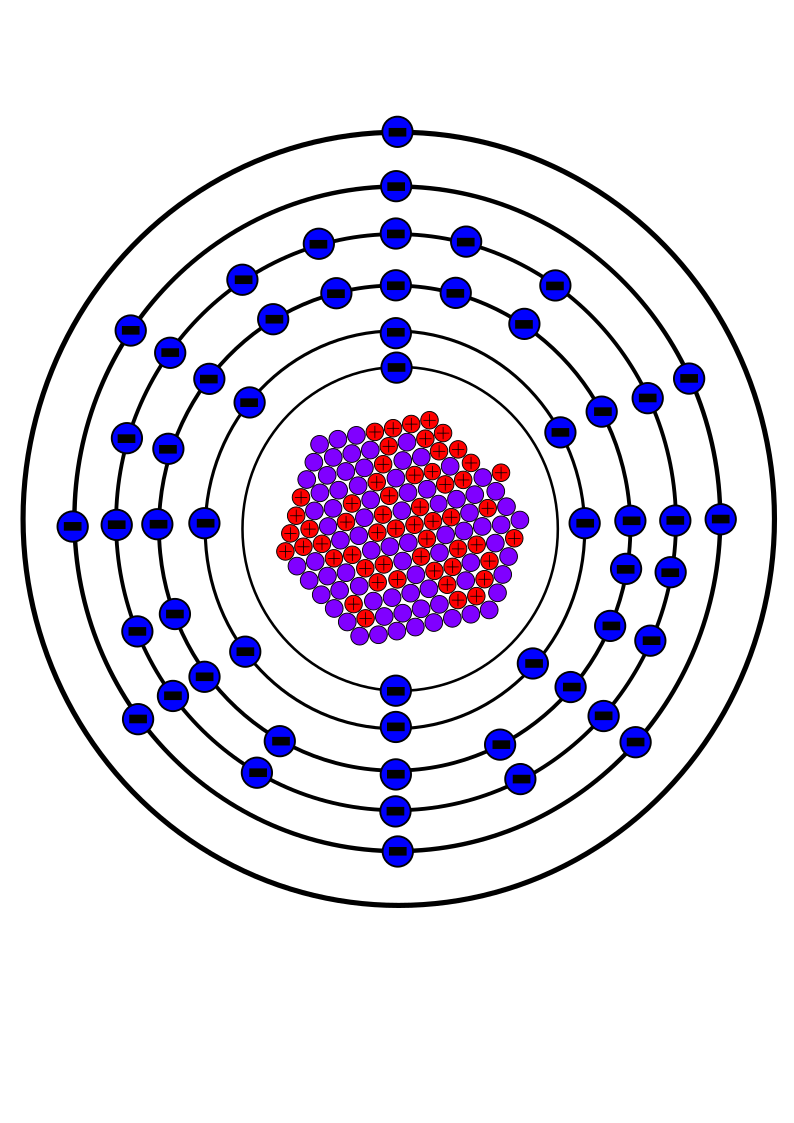
An atom contains a nucleus surrounded by electrons. Those electrons cannot simply have any amount of energy they want. Quantum mechanics allows them to occupy particular energy states.

Cesium-133 has two closely related energy states associated with the magnetic orientation of the atom's electrons and nucleus. The difference between these states is called the ground-state hyperfine transition.

When a cesium-133 atom is exposed to electromagnetic radiation at a very specific frequency, it can move between these two states.

That frequency is:

9,192,631,770 hertz.

A hertz means one cycle per second.

So the cesium transition corresponds to exactly 9,192,631,770 cycles every second.

The international definition takes that fixed frequency and uses it to define the second.

This is why the number is so important.

Scientists did not decide that a cesium atom "happens" to take exactly one second to do something.

Instead, the second is defined using the fixed frequency of this atomic transition.

In simple terms, we use cesium's natural behaviour to establish what one second means.

Diagram of a caesium-133 atom showing its protons, neutrons and electrons
A diagram of the caesium-133 atom. Image: SM358, Public domain, via Wikimedia Commons

What does the atomic clock actually count?

This is where an atomic clock becomes fascinating.

Imagine you have a group of cesium atoms inside a carefully controlled instrument.

You send microwave radiation toward them.

At first, the microwave frequency is slightly wrong.

The atoms do not respond strongly.

The frequency is adjusted.

As it approaches the correct frequency, more atoms undergo the transition between the two energy states.

When the microwave frequency reaches the resonance of cesium-133, the response becomes strongest.

The clock's electronics can detect this response and use it to keep the microwave oscillator locked to the correct frequency.

That oscillator then provides an extremely stable "tick" for the clock.

The clock does not have a tiny person inside counting:

9,192,631,769...

9,192,631,770!

Instead, electronic systems generate and count the oscillations of the electromagnetic signal while continuously checking the signal against the cesium atoms.

The atoms act as the reference.

The electronics do the counting.

Why exactly 9,192,631,770?

This number was not chosen randomly.

Scientists measured the frequency of the cesium transition and used it to establish the new definition of the second in 1967.

The definition was written as the duration of 9,192,631,770 periods of radiation corresponding to the transition between two hyperfine levels of the ground state of cesium-133. The wording was later revised in 2018 as part of the modern SI system, but the numerical value remained exactly the same.

The modern definition fixes the cesium frequency at exactly 9,192,631,770 hertz.

That is important because the number is no longer something scientists are trying to measure to discover what a second is.

The relationship is part of the definition itself.

It is similar to defining a unit using an exact mathematical relationship.

Does that mean every second is perfectly identical?

This is where things get a little more complicated.

The definition of the second is exact.

But no physical clock can reproduce the ideal definition with absolutely zero uncertainty.

Real atomic clocks have imperfections.

Their measurements can be affected by temperature, magnetic fields, electromagnetic radiation, motion of the atoms and other environmental factors. Scientists therefore design increasingly sophisticated clocks to control these effects.

Modern cesium fountain clocks can realize the second with extraordinary accuracy. NIST says the best cesium standards can reach uncertainties approaching one part in 10¹⁶.

That means scientists can maintain an astonishingly precise realization of the unit.

For comparison, ordinary quartz watches are nowhere near this level of precision. NIST notes that a typical quartz wristwatch may be accurate to around 15 seconds per month, while atomic clocks are vastly more stable.

So when we say "one second is exactly one second," we mean the unit itself has an exact scientific definition.

Our individual clocks are approximations of that definition.

What makes an atomic clock different from your phone?

Your phone has a clock.

Your laptop has a clock.

Your microwave probably has one too.

None of these devices contains a miniature cesium fountain.

Most everyday electronic devices use quartz oscillators to keep track of time locally. Quartz crystals vibrate at very stable frequencies when an electrical signal is applied to them.

They are extremely useful and inexpensive.

But quartz is not stable enough to serve as the world's ultimate time reference.

Atomic clocks provide the reference that much of modern technology depends on.

National laboratories operate highly precise clocks and compare their measurements to help construct international time scales. Signals from these clocks contribute to the coordinated time system used around the world.

Your phone may not contain an atomic clock, but the time displayed on it can ultimately be connected to atomic time through communication networks and time-distribution systems.

So the little clock in your corner of the screen is connected to an international network of incredibly precise timekeeping.

What about GPS?

Accurate time is not just useful for knowing whether you are late for class.

It is essential for GPS.

GPS satellites carry extremely accurate clocks. A GPS receiver determines its position by comparing the arrival times of signals sent from different satellites.

The signals travel at close to the speed of light.

That creates an important problem.

If your timing measurement is wrong by even a tiny amount, the calculated distance to a satellite can be wrong. The resulting position can therefore be wrong too.

Atomic clocks and precise timing are fundamental to satellite navigation systems. NIST notes that accurate clocks, together with relativity, are essential to GPS.

This is one of those cases where an idea that sounds abstract in a physics laboratory becomes part of everyday life.

Every time a phone tells you where you are on a map, extremely precise timing is involved somewhere in the system.

Time is not the same everywhere

There is another strange part of the story.

Einstein's theories of relativity tell us that time does not pass at exactly the same rate for every observer.

An atomic clock moving at a different speed from another clock can experience a different passage of time. Clocks at different gravitational potentials can also tick at different rates.

These effects are extremely small in everyday life.

But atomic clocks are sensitive enough to detect them.

That means scientists have had to take relativity into account when comparing clocks around the world.

The BIPM notes that the definition of the second corresponds to proper time and that relativistic corrections are required when combining measurements from clocks at different locations.

So there is a strange irony here.

We use atomic clocks to create an incredibly precise definition of a second, and those same clocks are precise enough to show that the rate at which time passes can depend on where you are and how you are moving.

The world's clocks do not all tick together

There is also a difference between the definition of a second and the time shown on clocks around the world.

Scientists maintain an international atomic time scale called International Atomic Time, or TAI.

But civil time is based on Coordinated Universal Time, or UTC.

Why not simply use atomic time and forget about the Earth?

Because people still live according to the rotation of the planet.

A day is connected to the Earth's relationship with the Sun. We expect noon to occur roughly when the Sun is highest in the sky.

But Earth's rotation is not perfectly uniform.

As atomic clocks became increasingly accurate, the difference between atomic time and astronomical time became noticeable.

For decades, leap seconds were occasionally inserted into UTC to keep it close to Earth's rotation.

The system is now being changed. In 2022, the General Conference on Weights and Measures decided to work toward eliminating the need for leap seconds by or before 2035, although the exact future implementation is still being developed.

This shows an interesting conflict.

Atomic time is extremely stable.

Earth's rotation is not.

Yet our daily lives are still organised around the planet.

Are scientists going to redefine the second again?

Possibly.

Scientists are already developing clocks that use optical frequencies instead of microwaves.

These clocks use transitions in atoms such as strontium, ytterbium and other elements. Their frequencies are much higher than the microwave frequency used by cesium clocks.

Higher frequencies allow researchers to divide time into even smaller intervals.

Some experimental optical clocks are already considerably more precise than the best cesium standards.

NIST reports that an experimental strontium optical lattice clock can be so stable that it would not gain or lose a second over a period longer than the current age of the universe under the stated conditions.

That does not mean scientists have already changed the official definition.

The international metrology community is studying the possibility of a future redefinition of the second. In 2022, the CGPM formally adopted a resolution concerning the future redefinition and noted that optical frequency standards had surpassed the accuracy achievable by the current cesium-based realization by large factors.

For now, cesium remains the foundation of the SI second.

So, is one second really one second?

Yes.

But not because someone looked at a stopwatch and decided that its ticking sounded about right.

A second is a scientific unit with an extraordinarily precise definition.

It is tied to a specific quantum transition in a cesium-133 atom. The defining frequency is exactly 9,192,631,770 hertz.

Atomic clocks use this natural atomic behaviour as a reference and continuously compare an electronic oscillator with it.

The reason we can trust modern timekeeping is not that mechanical clocks have somehow become perfect. It is that humans found something in nature that is remarkably stable and reproducible.

First, we measured time using the movement of the Sun.

Then we tried to improve the definition using astronomy.

Eventually, we discovered that atoms could do the job much better.

And now a single second, something that feels almost too ordinary to question, is connected to the behaviour of an atom vibrating billions of times every second.

The next time a clock changes from 20:14:36 to 20:14:37, there is a remarkable amount of science behind that tiny change.

One second is not just the space between two numbers on a clock.

It is one of the most precisely defined quantities in human measurement.

↑ Back to Contents ↻ Read This Article Again

06 / HUMAN BODY

Why Dopamine Makes You Want More

The chemical in your brain that does more than make you feel good

Three-dimensional molecular structure of dopamine
Three-dimensional structure of a dopamine molecule. Image: Benjah-bmm27, Public domain, via Wikimedia Commons

You finish a video and immediately open another one.

You hear the notification sound from your phone and check it before you even think about it.

You win a game and want to play again.

You smell your favourite food and suddenly feel like eating, even if you were not hungry a minute earlier.

What connects all of these moments?

Dopamine.

It is one of the most talked-about chemicals in the brain. It is often called the "pleasure chemical," and the internet is full of claims about dopamine being responsible for everything from social media addiction to motivation.

But the real story is more interesting.

Dopamine is not simply the chemical that makes you happy. It is involved in motivation, learning, movement, attention and the brain's response to rewards. One of its most important roles is helping make certain things feel worth pursuing.

In other words, dopamine can help turn "That was good" into "I want that again."

And that small difference is a big part of understanding why we keep chasing rewards.

Dopamine is not your brain's happiness button

Let's get the biggest misconception out of the way first.

Dopamine is not simply a chemical that gets released whenever you feel pleasure.

For years, scientists and popular media often connected dopamine with pleasure and reward. But research has shown that the brain's reward system is more complicated than that.

Scientists studying reward have separated it into different processes, including liking, wanting and learning.

"Liking" refers to the actual pleasurable experience of a reward.

"Wanting" refers more to motivation and the urge to pursue it.

"Learning" involves discovering which actions, objects or situations are associated with good or bad outcomes.

Dopamine is particularly important in the motivational side of this system. Research has found that dopamine-related brain circuits can make reward-related cues more attention-grabbing and motivating without necessarily increasing the pleasure produced by the reward itself.

That is why calling dopamine the "pleasure chemical" is an oversimplification.

A better description would be something like a chemical messenger deeply involved in motivation, learning and reward-related behaviour.

That may sound less catchy, but it is much closer to what the science actually tells us.

Your brain learns what is worth chasing

Imagine that you walk into a bakery.

Before you even buy anything, you smell freshly baked bread.

You know what that smell means.

Your brain has learned the connection between that smell and food. The smell can attract your attention and make food seem especially desirable.

This is where dopamine becomes interesting.

Reward-related cues can trigger dopamine-related activity and increase what neuroscientists call incentive salience. In simple terms, something that was previously just a neutral signal can become important, attractive and capable of pushing you toward a reward.

The smell of food can become a cue.

A notification can become a cue.

The sound of a game reward can become a cue.

Even a particular location can become associated with a rewarding experience.

Your brain is constantly learning these connections.

And once a cue becomes associated with a reward, encountering that cue can make you want to find out what comes next.

Sometimes the anticipation is more powerful than the reward

This is where the difference between "liking" and "wanting" becomes especially important.

Think about ordering your favourite meal.

There is the pleasure of actually eating it.

But there is also the anticipation before it arrives.

You imagine the taste.

You check how long the delivery will take.

You smell it when it arrives.

The anticipation itself can become motivating.

Research on dopamine and incentive salience suggests that dopamine-related systems are strongly involved in this motivational process. Reward cues can become powerful triggers for seeking behaviour, even before the reward itself appears.

This helps explain something that can happen in everyday life.

You can desperately want something and then discover that the actual experience is not as exciting as you expected.

You wanted it.

But you did not necessarily like it as much as you thought you would.

Those two experiences are not identical.

The notification is not the reward

Consider your phone.

You hear the familiar notification sound.

You pick it up.

You unlock the screen.

There is a new message.

Maybe it is interesting.

Maybe it is completely pointless.

Yet you checked anyway.

Part of what makes this behaviour powerful is that the notification itself can become a learned cue. Your brain has experienced a pattern in which the sound sometimes leads to something socially rewarding or interesting.

The important part is the uncertainty.

You do not know exactly what the notification contains.

That uncertainty can make the cue particularly attention-grabbing.

Dopamine neurons are involved in reward prediction and in signalling differences between expected and actual outcomes. This is often described as a reward prediction error. When an outcome is better or worse than expected, dopamine activity can change in ways that help update future behaviour.

So your brain is not simply asking, "Did I enjoy that?"

It is also learning:

"Was that better or worse than I expected?"

That information can influence what you do next time.

Your brain is constantly making predictions

Imagine you open a particular social media app.

You scroll.

The first few posts are boring.

Then you find something hilarious.

You keep scrolling.

Maybe the next thing is interesting too.

Maybe it is not.

You keep going anyway.

Part of the reason can be that your brain has learned that the next reward is uncertain.

This does not mean dopamine is literally saying, "Scroll five more times."

The brain is much more complicated than that.

Instead, dopamine-related signalling participates in learning and motivation systems that help organisms respond to reward-predicting cues and adjust behaviour when outcomes differ from expectations.

This is one reason unpredictable rewards can be so compelling.

If you already know exactly what will happen, there may be less information to learn.

If something surprising happens, your brain has something new to update.

Dopamine can make a cue hard to ignore

Imagine walking past a restaurant when you are hungry.

You smell something delicious.

Suddenly, the smell seems much more noticeable than everything else around you.

That is an example of how motivation can change attention.

A reward-related cue can become what neuroscientists call motivationally salient. It stands out and pulls your attention toward the possibility of obtaining the reward.

This process is not limited to food.

The same general principle can apply to many learned rewards.

A song can remind you of a particular experience.

A message can signal social interaction.

A game sound can signal that you have earned something.

A familiar logo can remind you of a product you enjoy.

The cue itself may not provide the reward.

But it can become associated with it.

Diagram of dopamine pathways in the human brain
Dopamine pathways in the human brain. Image: Jtneill, CC BY-SA 4.0, via Wikimedia Commons

This is where addiction becomes complicated

The distinction between wanting and liking becomes especially important in addiction research.

Normally, wanting and liking tend to work together.

You enjoy something, so you want it again.

But they can become separated.

Research on incentive sensitization suggests that repeated exposure to addictive substances can produce lasting changes in dopamine-related motivation systems. Cues associated with the substance can become unusually powerful triggers for wanting, even when the person gets less pleasure from the substance than they once did.

That creates a disturbing situation.

Someone can continue strongly wanting something even though they no longer enjoy it as much.

The brain is responding strongly to the cues and motivation to pursue the reward, while the actual pleasure may not increase with it.

This is one reason addiction cannot be explained simply by saying that people "keep doing it because it feels good."

The relationship between pleasure, motivation, learning and addiction is much more complicated.

Dopamine also helps you learn from mistakes

Dopamine is not only about things going well.

Your brain also needs to learn when its predictions are wrong.

Suppose you expect to receive a large reward and instead receive a small one.

That difference contains information.

Likewise, if something unexpectedly good happens, your brain has learned something new.

Research on dopamine neurons has linked their activity to reward prediction errors, a signal that helps the brain update expectations about future outcomes.

This is extremely useful.

Imagine an animal finding food in one location.

The first time, the food is a surprise.

The next time, the animal remembers the location.

Eventually, the location itself becomes a predictor.

The brain has learned.

Dopamine-related signalling is one part of the system involved in that process.

So dopamine is not simply helping us chase rewards.

It is also helping the brain learn which things are worth chasing.

What happens when motivation goes wrong?

Because dopamine is involved in motivation, changes in dopamine systems can have major effects on behaviour.

Too little or disrupted dopamine signalling in certain pathways can contribute to problems with motivation and movement. Dopamine is also particularly important in the brain's motor circuits.

One of the clearest examples is Parkinson's disease.

In Parkinson's disease, dopamine-producing neurons in a region of the brain called the substantia nigra progressively degenerate. The resulting disruption of dopamine signalling in motor circuits contributes to symptoms such as slowed movement, rigidity and tremor.

This is one reason medications that increase dopamine signalling can be useful in treating Parkinson's disease.

The important point is that dopamine is doing far more than making experiences enjoyable.

It is part of systems that help the brain decide when to act and how strongly to pursue something.

Dopamine exists outside the brain too

There is another detail that often gets missed.

Dopamine is not found exclusively in the brain.

It also functions as a signalling molecule in other parts of the body.

However, dopamine does different things depending on where it is acting.

In the brain, dopamine acts as a neurotransmitter, carrying signals between nerve cells and influencing several circuits.

Outside the brain, dopamine can act as a chemical messenger involved in physiological processes.

This is another reason why describing dopamine simply as "the pleasure chemical" is misleading.

It is one molecule involved in several different biological systems.

So does dopamine make you want more?

Sometimes, yes.

But the science is more precise than the phrase suggests.

Dopamine does not simply create an endless desire for everything.

Its effects depend on the brain circuit involved, the situation, the reward, previous learning and many other factors.

What dopamine-related systems can do particularly well is make certain rewards and their associated cues motivationally important.

That is why the smell of something you love can suddenly make you hungry.

Why seeing a familiar notification can make you reach for your phone.

Why the possibility of winning can keep you playing.

Why a remembered reward can make you seek it again.

And why an unexpected positive outcome can teach your brain that something may be worth pursuing in the future.

The strange thing about wanting

Perhaps the most surprising lesson from dopamine research is that wanting and liking are not the same thing.

You can want something without enjoying it very much.

You can enjoy something without constantly wanting more of it.

And sometimes the anticipation of a reward can be more motivating than the reward itself.

That distinction changes the way we think about everyday behaviour.

When you find yourself checking your phone again, opening another video or craving something you have associated with a reward, it is not simply because your brain is shouting, "Pleasure!"

Your brain has learned associations.

It has built expectations.

It has noticed cues.

And dopamine is one of the chemical messengers helping turn those learned signals into motivation.

That is why dopamine is so fascinating.

It is not just about feeling good.

It is about wanting, learning, predicting and acting.

And sometimes, that little push toward "one more" is enough to keep us going long after the original reward has stopped being particularly rewarding.

↑ Back to Contents ↻ Read This Article Again

07 / GEOGRAPHY

How Earth Built the Andes

The enormous collision beneath South America that built one of Earth's longest mountain ranges

Aconcagua seen from a commercial flight between Buenos Aires, Argentina, and Santiago de Chile
Aconcagua, the highest mountain outside Asia. Image: Bjørn Christian Tørrissen, CC BY-SA 4.0, via Wikimedia Commons

The Andes look as though they have always been there.

Stretching for roughly 7,000 kilometres along the western edge of South America, they pass through seven countries and contain some of the highest peaks on Earth. Their slopes hold glaciers, deserts, forests and high-altitude plateaus. Volcanoes rise from parts of the range, while earthquakes regularly shake the ground beneath it.

It is easy to look at the Andes and think of them as a permanent part of the planet.

They are not.

The Andes are the result of an enormous geological process that has been shaping western South America for tens of millions of years. Deep beneath the Pacific Ocean and the South American continent, pieces of Earth's crust are constantly moving.

The movement is incredibly slow. Usually only a few centimetres per year.

But given millions of years, a few centimetres becomes thousands of kilometres.

That slow movement is one of the reasons the Andes exist.

It starts beneath the Pacific

Earth's outer layer is not one solid shell.

The rigid outer part of the planet is divided into enormous pieces called tectonic plates. These plates move over the hotter, weaker material beneath them.

South America sits on the South American Plate.

To its west, beneath the Pacific Ocean, lies the Nazca Plate.

The two plates are moving toward one another. The Nazca Plate is being forced beneath the South American Plate in a process known as subduction.

This is the fundamental process behind much of the geology of the Andes.

The Nazca Plate is made mainly of oceanic crust, which is denser than the continental crust of South America. As the plates converge, the denser oceanic plate bends downward and sinks into Earth's mantle.

It does not disappear instantly.

Instead, it descends gradually into the planet.

The boundary where this happens is called the Peru-Chile Trench, which runs along much of the western coast of South America.

Far below the surface, the same collision continues.

And this is where things become interesting.

Map showing the tectonic plates around South America
Tectonic plates around South America. Image: USGS, cropped by Beyond My Ken, Public domain, via Wikimedia Commons

A mountain range does not simply appear

It would be easy to imagine the Andes forming like a giant sheet of paper being pushed from both sides and folding upward.

The real process is much more complicated.

As the Nazca Plate moves beneath South America, it pushes against the continental crust above it. Over enormous periods of time, this compression can shorten and thicken parts of the crust.

Thicker crust can rise higher.

The result is a broad region of uplift rather than a simple line of rock being pushed upward.

The Andes therefore did not form in one sudden collision.

They developed through repeated geological processes involving compression, faulting, folding, uplift, volcanic activity and erosion.

Different parts of the range have also formed and changed at different times.

Some of the major phases of Andean mountain building occurred during the Cenozoic Era, particularly over the last several tens of millions of years.

The mountains we see today are the result of that long history.

The Andes are still being built

The most fascinating part is that the process has not stopped.

The Nazca Plate is still moving beneath the South American Plate.

The movement varies along the boundary, but in many places the convergence is measured in centimetres per year.

That sounds insignificant.

Imagine moving a pencil across a desk by just a few centimetres.

You would barely notice it.

Now imagine that same movement continuing for one million years.

The distance becomes tens of kilometres.

Continue it for tens of millions of years and the numbers become enormous.

Geology operates on timescales that are almost impossible for humans to imagine.

A mountain can rise gradually while erosion is simultaneously wearing it down.

Rain, rivers, glaciers, landslides and wind all remove material from the mountains.

At the same time, tectonic forces can continue lifting and deforming the crust.

The Andes are therefore caught between two enormous forces.

The planet builds them.

The planet wears them down.

Why are there so many volcanoes?

Look at a map of South America and another feature of the Andes becomes obvious.

There are a large number of volcanoes along the western side of the continent.

That is not a coincidence.

Subduction is closely connected to volcanic activity.

As the Nazca Plate descends into Earth's mantle, it carries water and other volatile materials down with it. These materials can contribute to melting in the mantle above the descending plate.

The resulting magma can rise toward the surface.

Some of it eventually erupts through volcanoes.

This is why the Andes are home to one of the world's major volcanic regions.

The volcanic zone is part of the larger Pacific Ring of Fire, a broad belt around much of the Pacific Ocean where numerous earthquakes and volcanoes occur.

Not every volcano in the Andes is active today, and volcanic activity is not identical along the entire mountain range. But the connection between subduction and volcanism is one of the clearest examples of how activity deep inside Earth can shape what happens at the surface.

The mountains and volcanoes are part of the same much larger geological system.

Map of the Nazca Plate
The Nazca Plate beneath the Pacific Ocean, moving toward South America. Image: edits by Ingo Wölbern, Public domain, via Wikimedia Commons

The same collision produces earthquakes

The collision beneath the Andes has another consequence.

Earthquakes.

The boundary between the Nazca and South American plates is one of the most seismically active regions on Earth.

As the plates move against one another, sections of the boundary can become locked by friction.

The plates continue trying to move.

Stress builds.

Eventually, a section can suddenly slip.

The stored energy is released as seismic waves.

That is an earthquake.

Some earthquakes occur deep beneath the continent as the Nazca Plate continues its descent. Others occur near the plate boundary itself.

The largest earthquakes can be devastating.

The 1960 Valdivia earthquake in Chile, for example, reached a magnitude of about 9.5 and remains the largest earthquake ever recorded instrumentally.

It generated a massive tsunami that crossed the Pacific Ocean.

That event was not an isolated accident.

It was a consequence of the same tectonic setting responsible for the Andes.

The mountain range, the volcanoes and the earthquakes are all connected to the movement of Earth's plates.

But the Andes are not just one giant wall

Another interesting thing about the Andes is their enormous variety.

They are not a single uniform chain of mountains.

The range contains several distinct geological regions.

In the central Andes, for example, the Altiplano forms a huge high-elevation plateau between mountain ranges. Parts of it sit more than 3,500 metres above sea level.

The Altiplano is one of the world's highest inhabited regions.

Further north, the Andes extend through Colombia and Ecuador, where the landscape contains high volcanic peaks and deep valleys.

In Chile and Argentina, the range includes some of the highest mountains in the Western Hemisphere.

Aconcagua, in Argentina, reaches about 6,961 metres above sea level. It is the highest mountain outside Asia.

The enormous variety exists because the geological processes affecting the Andes are not identical everywhere.

The angle at which the Nazca Plate descends changes from place to place. The crust also differs along the continent, and erosion, volcanism and uplift have affected different regions in different ways.

The result is a mountain system rather than one simple wall of rock.

The Andes can change the weather

The Andes do not only respond to the atmosphere.

They also influence it.

Because the mountains rise so high, they act as a massive barrier to moving air.

Moisture carried from the Amazon Basin toward the west encounters the mountains and is forced upward. As air rises, it cools, allowing water vapour to condense and produce precipitation.

This helps make parts of the eastern Andes much wetter than areas farther west.

On the other side of the mountains, the situation can be dramatically different.

The Atacama Desert in northern Chile and southern Peru is one of the driest places on Earth. The Andes contribute to the region's extreme dryness by affecting atmospheric circulation and blocking moisture from the Amazon side.

The mountains therefore help create a remarkable contrast.

On one side, enormous amounts of moisture can fall as rain or snow.

On the other, landscapes can remain extraordinarily dry.

The Andes are not solely responsible for the Atacama's climate. Ocean currents and atmospheric circulation also play important roles. But the mountain range is a major part of the system.

The mountains hold enormous amounts of water

The Andes are also important because of their glaciers and snowfields.

High-altitude ice stores water that can be released gradually as temperatures rise.

For communities in the Andes and surrounding regions, mountain water is extremely important for drinking, agriculture, ecosystems and energy production.

Some rivers originating in the Andes eventually flow into the Amazon Basin, while others reach the Pacific coast.

This makes the mountains an important source of water for millions of people.

But the region is changing.

Many Andean glaciers have been shrinking in recent decades as temperatures rise, although the exact changes differ from one glacier and region to another.

That creates concerns about future water supplies, particularly in places where communities depend heavily on glacier and snow melt during dry periods.

The mountains were created by tectonic forces operating over millions of years.

Their water resources, however, can change much faster.

Why didn't the mountains become even higher?

If the plates are continuously pushing against one another, there is a natural question.

Why don't the Andes simply keep getting taller?

The answer is erosion.

Mountains are constantly being attacked by the environment.

Rain breaks down rock.

Rivers carry sediment downhill.

Glaciers carve valleys.

Landslides remove huge quantities of material.

Wind carries away smaller particles.

At the same time, tectonic forces can continue pushing and uplifting the crust.

The final height of a mountain is therefore the result of competing processes.

Tectonic forces push and deform the crust.

Erosion removes material.

Climate affects the rate of erosion.

Rock strength influences how landscapes respond.

Over millions of years, these processes interact.

A mountain range is not a finished structure.

It is a changing landscape.

Volcanoes of the Andes
Volcanic landscapes of the Andes. Image: Alexander Gerst, CC BY-SA 2.0, via Wikimedia Commons

Earth is still moving beneath the Andes

Standing in the Andes, you would not feel the continent moving beneath your feet.

The motion is far too slow.

The Nazca Plate does not suddenly crash into South America like two cars in a collision. It moves gradually, usually by only a few centimetres per year.

That slow movement is deceptive.

If you could speed up geological time and watch millions of years pass in a few seconds, the landscape would look completely different.

Rocks would fold.

Faults would move.

Volcanoes would erupt.

Mountains would rise.

Other mountains would be eroded away.

Rivers would change their paths.

The coastline itself would gradually be reshaped.

The Andes are therefore not the remains of a geological event that happened once in the distant past.

They are part of a process that is still happening.

What happens if the plates eventually stop?

The Andes will not remain exactly as they are forever.

If the tectonic forces responsible for their uplift eventually weaken or change, erosion will continue working on the mountains.

Given enough time, mountains can become lower and smoother.

But that does not mean the Andes are going to disappear anytime soon.

Geological time is enormous.

Even if the processes responsible for mountain building changed tomorrow, the range would still exist for millions of years while erosion gradually reshaped it.

And the tectonic boundary is not expected to simply switch off in the foreseeable geological future.

For now, the Nazca Plate continues its slow descent.

The South American Plate continues to respond.

And the Andes continue to change.

A mountain range built by invisible movement

The Andes are a good reminder that some of Earth's most dramatic landscapes are created by processes that are almost impossible to notice in everyday life.

We can see the mountains.

We can see the volcanoes.

We can see rivers cutting through valleys and glaciers covering high peaks.

But we cannot see the enormous plates moving beneath our feet.

They move only centimetres each year.

That seems almost insignificant.

Yet over millions of years, those centimetres have helped build one of the longest mountain systems on Earth.

The Andes were not created in a single explosion or a single collision.

They were built slowly, through the movement of tectonic plates, the compression and deformation of Earth's crust, volcanic activity and countless other geological processes.

And the construction project is not finished.

Every year, the Nazca Plate continues to move beneath South America.

Every year, erosion continues to wear the mountains down.

Earth is simultaneously building the Andes and taking them apart.

We just happen to live on a timescale too short to watch it happen.

↑ Back to Contents ↻ Read This Article Again

08 / HISTORY

How the Wheel Changed Everything

The simple invention that transformed transport, trade, machines and human history

Ljubljana Marshes Wheel with axle (oldest wooden wheel yet discovered)
The Ljubljana Marshes Wheel with its axle, one of the oldest wooden wheels yet discovered. Image: Petar Milošević, CC BY-SA 4.0, via Wikimedia Commons

It is hard to imagine a world without wheels.

They are under cars, buses and trains. They are inside clocks, engines and factory machines. They move elevators, conveyor belts and bicycles. Even many devices that do not obviously look mechanical depend on rotating parts somewhere inside them.

The wheel is so common that we barely notice it.

But there was a time when humans had never seen one.

There was no single inventor who suddenly looked at a circular object and changed the world. The story is much less simple. The wheel developed alongside other technologies, and its usefulness depended on another invention that is easy to overlook: the axle.

Together, the wheel and axle created one of the most useful mechanical systems humans have ever developed.

The consequences reached far beyond transportation.

The wheel changed how people moved, traded, worked, fought and built. Thousands of years later, the same basic idea would become part of machinery, factories, engines and modern transportation.

A circle of wood became one of the foundations of technological civilization.

Before the wheel, moving things was hard

Humans had been moving heavy objects long before wheels appeared.

They could carry loads, drag them across the ground or place them on sledges. A sledge could reduce friction compared with dragging an object directly, making it easier to move heavy materials.

But there was a major limitation.

Dragging still required enormous effort.

Rolling is different.

When an object rolls, the contact between the object and the ground changes continuously. The resistance involved can be much lower than sliding a heavy object across a surface.

That does not mean ancient people simply discovered that rolling was easier and immediately invented the wheel.

A practical wheel is surprisingly complicated.

You need a strong circular structure. You need an axle. The wheel needs to rotate properly. The connection between the wheel and axle has to work without breaking under the load.

The materials also have to be shaped accurately enough for the system to function.

The wheel was therefore not just a brilliant idea.

It was an engineering problem.

Nobody knows who invented it

There is no historical record telling us who first invented the wheel.

The earliest evidence for wheeled vehicles appears around the 4th millennium BCE, roughly 5,000 to 6,000 years ago. Archaeological evidence from Europe and western Asia shows that wheeled transport appeared during this period. The exact location and sequence of development remain subjects of archaeological research.

That means we should be careful with the popular image of one prehistoric inventor suddenly having the idea.

The technology probably emerged from earlier experiments with rotating objects, sledges, carts and other forms of transport.

There is also evidence that rotating technology was used for purposes other than transportation.

The potter's wheel, for example, allowed craftspeople to rotate clay while shaping vessels. Wheel-based pottery technology developed in parts of the ancient world thousands of years ago.

This is an important detail.

The first important use of the wheel may not have been putting it on a cart.

The ability to make something rotate in a controlled way was useful on its own.

A jug from Bronocice, 3,550 BC. Chr.
A vessel from Bronocice, dating to around 3550 BCE, bearing an early depiction associated with wheeled transport. Image: Silar, CC BY-SA 3.0, via Wikimedia Commons

The real breakthrough was the wheel and axle

A wheel by itself is not enough to create a useful vehicle.

The crucial combination is the wheel and axle.

The axle provides a central support around which the wheel can rotate. Once engineers learned how to arrange the wheel and axle effectively, an object could be supported while its wheels turned beneath it.

This sounds obvious now.

It was not obvious thousands of years ago.

The Smithsonian's history of the wheel describes the development of early wheels attached to axles around 4000 BCE, followed later by systems in which wheels could rotate independently on their axles.

That distinction mattered.

It allowed people to build increasingly practical carts and vehicles.

The invention was no longer simply a circular piece of wood.

It had become a mechanical system.

Then animals made the wheel much more powerful

The wheel became dramatically more useful when combined with animal power.

A person pulling a heavy cart has obvious limits.

A horse, ox or other draft animal can provide much more sustained pulling power.

Once wheeled vehicles could carry heavy loads, animals could pull them over roads and paths.

This changed transportation.

A load that once required many people could potentially be moved by a smaller team.

That had consequences far beyond convenience.

Goods could travel farther.

People could move more quickly.

Agricultural products could be transported.

Raw materials could reach settlements.

Trade networks could expand.

The wheel therefore became part of a much larger technological system involving animals, roads, carts and eventually more sophisticated vehicles.

The invention did not change civilization by itself.

It changed what humans could do when combined with other technologies.

The wheel changed trade

Imagine living in a settlement thousands of years ago.

You produce grain, pottery, metal or other goods.

Nearby communities have things you do not have.

The problem is transportation.

If everything must be carried by people, moving large quantities over long distances becomes expensive and slow.

Wheeled vehicles changed that calculation.

They made it easier to transport heavier loads across suitable terrain.

That helped support larger trade networks.

The effect would not have been identical everywhere. Terrain, road quality, animal availability and climate all affected how useful wheeled transport was.

A wheel is extremely useful on a reasonably smooth surface.

It is much less useful on extremely rough ground.

That is one reason the history of wheeled transport is not simply a story of "people invented wheels and everything became easier."

Technology always interacts with geography.

The wheel also changed warfare

Once people could move heavy equipment more efficiently, military technology changed too.

Chariots became important in several ancient societies.

They were not simply primitive cars.

A chariot was a specialised military system combining wheels, horses, construction techniques, weapons and trained people.

Lightweight spoked wheels made vehicles faster and more manoeuvrable than earlier solid-wheel designs.

Chariots became associated with warfare, hunting, transport and political status in different societies.

Their importance varied enormously by region and period, but the basic principle was the same.

A rotating wheel allowed a vehicle and its occupants to move more efficiently than carrying or dragging the same weight.

The consequences could reach the battlefield.

The wheel had become part of military technology.

History of technology
An ancient chariot from Ur, illustrating the early military and transportation uses of wheeled vehicles. Image: Anonymous, Public domain, via Wikimedia Commons

But the wheel's greatest revolution was still coming

For thousands of years, people used wheels mainly for transportation and crafts.

Then humans began finding new ways to use controlled rotation.

This was when the wheel became something much bigger than a vehicle component.

A rotating wheel can transfer motion.

It can change speed.

It can change direction.

It can transfer mechanical power from one part of a machine to another.

And that opens the door to gears.

When wheels started talking to other wheels

A gear is essentially a wheel designed to transfer rotational motion through teeth.

Two gears can rotate together.

One can turn the other.

Different-sized gears can change the relationship between speed and force.

This simple principle became fundamental to mechanical engineering.

Gears eventually appeared in clocks, mills, machinery, vehicles and countless other devices.

A small gear can turn a larger one.

A large gear can turn a smaller one.

The relationship between them can be designed to produce different speeds and amounts of torque.

Suddenly, the wheel was no longer simply helping something move across the ground.

It was helping machines move themselves.

That was a major step toward mechanical technology.

Gears
Gears use rotating wheels with teeth to transfer motion and mechanical power. Image: Kaushik.chug, CC BY-SA 3.0, via Wikimedia Commons

The wheel helped machines use power

The history of human technology contains many examples of people using rotating machinery to convert energy into useful work.

Water wheels could capture the energy of flowing water.

Windmills could use moving air.

Rotating mechanisms could grind grain, pump water and perform other tasks that would otherwise require human or animal labour.

The basic principle was beautifully simple.

Something rotates.

The rotation is transferred through mechanical components.

The machine performs useful work.

The wheel had become part of an energy system.

This was one reason its importance grew far beyond transportation.

Waterwheel that used to crush grain into flour
A waterwheel used to convert the energy of flowing water into useful mechanical work. Image: Kernow Skies, CC BY-SA 3.0, via Wikimedia Commons

Then came the Industrial Revolution

By the Industrial Revolution, rotating machinery had become central to industrial production.

Factories increasingly relied on systems of shafts, gears, wheels and belts to transfer mechanical power between machines.

Steam engines provided a new source of mechanical energy, and that energy could be transferred through rotating machinery.

The connection between wheels and industrialisation was not simply that factories had bigger wheels.

The important idea was controlled mechanical motion.

Machines could now perform repetitive work at a scale that human muscles alone could not match.

The result was a transformation in manufacturing, transportation and economic life.

Textile production is one example. Industrial machinery made it possible to produce fabrics at much greater speed and scale. The development of factory systems and machines during the Industrial Revolution fundamentally changed production and consumption.

The wheel was not responsible for the Industrial Revolution on its own.

Steam power, metallurgy, coal, engineering, capital, labour and many other factors were essential.

But rotating machinery was one of the ways these new energy sources became useful.

The wheel eventually became almost invisible

Today, we rarely think about the wheel when we think about advanced technology.

We think about computers, artificial intelligence, rockets and satellites.

But inside many advanced machines are still rotating components.

Cars depend on wheels and rotating shafts.

Aircraft engines contain rotating parts.

Factories use rollers, gears, bearings and conveyor systems.

Wind turbines rotate.

Electric motors rotate.

Generators rotate.

Clocks use gears and wheels.

Even something as simple as a bicycle combines wheels, gears, chains and bearings into a highly efficient mechanical system.

The underlying idea has not disappeared.

It has become so successful that it has become ordinary.

Why didn't every ancient civilization use wheels for transport?

There is a fascinating misconception about the wheel.

People sometimes assume that once humans invented it, every society immediately adopted wheeled transportation.

That did not happen.

The usefulness of wheels depends heavily on the environment.

A cart works well on relatively suitable surfaces. It becomes much less practical across dense forests, steep mountains, swamps or terrain without usable paths.

Animals also matter.

A society with suitable draft animals has different transportation possibilities from one without them.

Roads matter too.

A wheel is much more useful if there is infrastructure that allows it to travel.

This is an important lesson in technological history.

An invention does not automatically transform society simply because it exists.

It becomes transformative when the surrounding technology, environment and social conditions allow people to use it effectively.

The wheel did more than move objects

This is perhaps the most important part of its history.

If the wheel had only been useful for moving carts, it would still have been an extraordinary invention.

But its real influence came from something more fundamental.

Rotation is useful.

Once humans learned how to control rotation, they could use it for pottery, transport, machinery, power transmission and precision engineering.

The wheel became a building block.

A wheel could become a gear.

A rotating shaft could transfer power.

A water wheel could capture energy.

A pulley could redirect force.

A flywheel could store rotational energy.

A bearing could reduce friction between moving parts.

Modern engineering contains countless variations of these basic ideas.

The original wooden wheel is only one early expression of a much larger principle.

One invention, thousands of consequences

It is difficult to point to a single invention and say that it changed everything.

Human development does not work that way.

Technology is usually built from many ideas that connect with one another.

The wheel became powerful because humans combined it with axles, animals, roads, metals, gears, engines and other technologies.

That combination changed what societies could transport and manufacture.

It helped connect communities.

It supported trade.

It contributed to military technology.

It became part of machines.

Eventually, it became part of the industrial systems that transformed the modern world.

And through all of these changes, the basic idea remained remarkably simple.

A circular object can rotate.

That rotation can reduce resistance.

It can transfer motion.

It can transfer power.

It can make work easier.

The invention we stopped noticing

Today, a wheel can seem almost too simple to deserve much attention.

A child can draw one in a few seconds.

A car has four of them.

A bicycle has two.

A shopping cart has several small ones.

There is nothing mysterious about it anymore.

But imagine a world before anyone had figured out that controlled rotation could be turned into useful mechanical work.

There would be no wheeled carts.

No bicycles.

No cars.

No trains.

No gears in the machines we know today.

No water wheels or windmills in their familiar forms.

The modern world would be almost impossible to recognise.

The wheel did not create civilization by itself.

Humans did.

But the wheel gave those humans a new way to move things, transfer energy and build machines.

It began as a simple solution to a mechanical problem and became part of technologies that eventually transformed almost every part of human life.

Perhaps that is what makes the wheel so remarkable.

It is not the most complicated invention humans have ever created.

It may be one of the simplest.

Yet thousands of years after its first appearance, we are still building our world around it.

↑ Back to Contents ↻ Read This Article Again

09 / TECHNOLOGY

What If the Internet Disappeared for One Day?

24 hours without the invisible system holding modern life together

A world without internet connectivity

Imagine waking up tomorrow morning and reaching for your phone.

No messages.

No Instagram.

No YouTube.

No Google.

You try opening a website. Nothing loads.

You check your Wi-Fi. It says you are connected.

You restart the router.

Still nothing.

Then you hear that it is not just your house. It is not just your city. The internet has disappeared everywhere.

Not slowed down.

Not partially blocked.

Gone.

For the next 24 hours, billions of people would suddenly discover how much of ordinary life depends on something they rarely think about.

There would not be an instant return to the Stone Age. Electricity would still work. Cars would still have engines. Many television and radio broadcasts could continue. People could still use devices and local computer networks.

But the systems connecting those devices to the rest of the world would be missing.

And the effects would spread much further than social media.

The first hour would feel strangely quiet

The first reaction would probably be confusion.

People would assume the problem was local.

They would restart routers, switch between Wi-Fi and mobile data, call their internet providers and try different websites. Then the reports would start appearing through television, radio and other remaining communication systems.

The internet is not one giant machine with a single off switch. It is a network of thousands of independently operated networks connected through physical cables, data centres, routers and other infrastructure.

That is also why a total worldwide disappearance is extremely difficult to imagine as a realistic technical event.

The scenario here is therefore hypothetical: assume that, somehow, global Internet connectivity stops working for exactly 24 hours while electricity and the underlying physical infrastructure remain intact.

That distinction matters.

Your computer would not suddenly stop working.

Your files stored locally would still be there.

Your camera would still take photographs.

Your car would still be a car.

But anything that requires reaching a server somewhere else would start failing.

And that is where things get complicated.

The first thing you would notice: nothing can be found

The internet depends on several systems working together.

One of the most important is the Domain Name System, or DNS.

DNS translates names such as a website's domain name into the numerical network addresses computers use to communicate.

It is often compared to a phone book for the internet.

We normally type a name.

The network needs an address.

During Meta's major 2021 outage, for example, problems with the company's network caused its DNS services to become unreachable, preventing other parts of the internet from finding Meta's servers even though those servers themselves were still operating.

In our hypothetical worldwide outage, DNS would be only one piece of a much larger failure.

The underlying routes connecting networks would be unavailable too.

The result would be simple from a user's perspective.

You click.

Nothing happens.

Your bank balance might still exist

This is where the situation becomes less dramatic than movies might suggest.

Your money would not simply vanish because the internet stopped.

Banks maintain databases and physical infrastructure. The records representing balances and transactions do not exist only inside your phone.

But accessing those systems would become difficult.

Online banking would stop working.

Mobile banking applications would be unable to contact their servers.

Digital payment systems that depend on internet connectivity would be disrupted.

Businesses would have trouble communicating with banks and payment processors.

Card payments would become unreliable or unavailable in many situations, depending on the specific payment system and whether it had an offline capability.

Financial institutions would therefore move toward contingency procedures.

The financial sector is particularly dependent on communications networks because transactions, market operations and other financial processes rely heavily on data transmission. CISA lists financial services among the critical infrastructure sectors dependent on communications systems.

The important point is that the banking system would not necessarily be destroyed.

It would be isolated.

And isolation is enough to cause serious problems.

Cash would suddenly become very useful

One of the strangest changes would happen at places people visit every day.

Shops.

Restaurants.

Petrol stations.

Supermarkets.

Imagine standing at a checkout with a basket full of groceries.

You tap your card.

Declined.

You try your phone.

Nothing.

The shop's payment terminal may be perfectly functional, but if it needs to communicate with a remote payment system, the transaction cannot be completed normally.

Some payment systems can process certain transactions offline or temporarily store information, but those capabilities have limits.

Businesses would quickly start asking customers to pay with cash.

The problem is that even getting cash could become difficult.

ATMs generally communicate with banking networks.

If that communication is unavailable, many machines would not be able to provide normal service.

Within hours, cash in people's wallets could become much more valuable than the money sitting in an account they cannot access.

Hospitals would not simply shut down

This is another area where the reality is more complicated than the popular idea that "everything stops."

Hospitals have systems that can continue operating locally.

Doctors can still treat patients.

Medical equipment can still function.

Emergency departments can still receive people.

But modern healthcare relies heavily on communication networks.

Electronic health records, digital imaging systems, laboratory systems, electronic prescriptions, telemedicine and communication between different facilities can depend on network connectivity.

Research into large telecommunications outages has found that healthcare organisations can experience disruption to patient-facing and operational services when network connectivity fails.

So hospitals would likely move toward contingency procedures.

Paper records could return.

Staff might have to communicate directly instead of through networked systems.

Some digital information might remain accessible on local systems.

The result would not be instant medical collapse.

It would be slower, more complicated and more labour-intensive healthcare.

And that distinction is important.

Airports would have a very bad day

Air travel is another example of a system that would not necessarily stop completely but would become extremely difficult to operate normally.

Air traffic control is not simply "the internet." Aviation uses specialised communication and navigation systems, many of which have their own infrastructure.

But airlines, airports and passengers depend heavily on network connectivity for scheduling, ticketing, baggage processing, passenger information, crew coordination and many other tasks.

Flights already in the air could continue under aviation procedures.

The bigger problem would be everything surrounding them.

Passengers might be unable to check in normally.

Airlines might struggle to access reservation systems.

Baggage information could become difficult to exchange.

Airports would have to rely on backup procedures and local systems wherever available.

The longer the outage lasted, the more difficult it would become to keep the entire system operating smoothly.

Supply chains would begin to feel the pressure

This might become one of the biggest problems.

Modern supply chains depend heavily on information.

A supermarket does not simply wait until its shelves are empty and then order more products.

Its inventory systems track what is being sold.

Suppliers receive orders.

Warehouses track stock.

Trucks receive schedules.

Ports coordinate cargo.

Factories communicate with suppliers.

Banks process payments.

Companies exchange documents.

Much of that information moves through networked systems.

CISA describes communications systems as a dependency for transportation, energy, water, emergency services and other critical infrastructure sectors.

If the internet disappeared for 24 hours, trucks would not suddenly disappear from the roads.

Factories would not all stop immediately.

But the flow of information coordinating them would become much harder.

A one-day outage could therefore create problems that continue after the internet returns.

A delayed shipment can cause another shipment to be delayed.

A missed order can create a shortage.

A payment failure can postpone a transaction.

A system that is designed around continuous digital communication can become surprisingly inefficient when that communication disappears.

Your favourite apps would not be the biggest problem

Social media would disappear.

Streaming services would disappear.

Online games would stop working.

Cloud-based applications would become inaccessible.

Video calls would fail.

Email would stop.

Search engines would be unreachable.

But these would probably not be the most serious consequences.

They would simply be the most visible ones.

The more important issue is that the internet has become infrastructure for other infrastructure.

CISA describes communications as a dependency for energy, transportation, water, emergency services and financial services.

That means an internet outage can become a problem somewhere that does not look like an internet problem at all.

A payment failure.

A delayed shipment.

A communication failure between organisations.

A hospital system becoming unavailable.

A company losing access to cloud software.

A transport operator losing access to scheduling information.

The internet is increasingly hidden underneath ordinary activities.

What about electricity?

This is where the scenario becomes especially interesting.

The electricity grid is not simply controlled through the public internet.

Power systems use specialised operational technology and communications networks, and many critical components have redundancy and local controls.

So a global internet outage would not automatically mean the entire world goes dark.

However, energy systems do depend on communications networks for monitoring, control, coordination and other operations. CISA explicitly identifies communications as an important dependency for energy systems.

A carefully designed contingency system could keep many parts of the grid operating.

But operators would have a much harder job coordinating everything.

The same principle applies to water treatment and other utilities.

The infrastructure would still physically exist.

The information connecting its different parts would be impaired.

Your phone would become a very different device

Your smartphone would still work.

You could use the camera.

You could play downloaded music.

You could open files stored locally.

You could use some offline applications.

You could take photographs and videos.

But the most powerful feature of the modern smartphone would disappear.

Its connection to the rest of the world.

No cloud backups.

No live maps.

No messaging.

No social media.

No online search.

No streaming.

No app updates.

A smartphone without network access would suddenly feel much more like an extremely powerful offline computer.

And people would probably discover how much of their digital lives they have stopped storing locally.

Remote work would become impossible

For millions of people, the workplace is now partly digital.

Documents may live in cloud services.

Meetings happen through video calls.

Projects are managed through online platforms.

Messages move through collaboration tools.

Code is stored in remote repositories.

Customer information may live in cloud databases.

Remove the internet and many of these workplaces would simply lose access to the systems they use every day.

Some businesses could continue using local networks and locally stored files.

Others would be almost completely unable to operate.

This is one reason recent large-scale outages have been so disruptive even when the underlying physical infrastructure remained intact.

Cloudflare's February 2026 outage, for example, made some customer services unreachable because network routes were unintentionally withdrawn through BGP. The incident lasted more than six hours and demonstrated how a problem in a foundational networking layer can affect services that depend on it.

A global outage would obviously be far larger.

News would become strangely old-fashioned

Without the internet, information would move much more slowly.

Television and radio could still broadcast.

Newspapers could still print if their production systems and distribution networks remained functional.

But the instant global flow of information would disappear.

There would be no social media feeds updating every few seconds.

No live comment sections.

No instant video uploads.

No online headlines changing throughout the day.

People would have to wait for scheduled broadcasts or physical newspapers.

Rumours would still spread.

Humans do not need the internet to spread rumours.

But verifying those rumours would become much harder.

For the first time in years, many people would experience a world where information was not immediately available whenever they wanted it.

What happens to emergency services?

This could become one of the most serious concerns.

Emergency services rely on communication systems to receive calls, dispatch responders and coordinate operations.

CISA specifically identifies communications networks as important to emergency services for receiving emergency calls, dispatching resources and coordinating responses.

A total internet disappearance would not necessarily disable every emergency communication system because emergency services can use dedicated radio and telecommunications infrastructure.

But the overall communication environment would be degraded.

People would have fewer ways to contact organisations.

Authorities would rely more heavily on radio, television, fixed telephone systems and local communication networks.

In a major emergency occurring during the outage, the ability to coordinate information could become one of the biggest challenges.

After 12 hours, people would start adapting

Humans are surprisingly good at adapting when systems fail.

Offices would start using paper.

Businesses would write down orders.

People would meet in person.

Radio would become more important.

Cash would become more useful.

Local networks would be used wherever possible.

People would call each other through whatever communication systems remained available.

Some businesses would simply close for the day.

Others would continue operating manually.

And something unexpected might happen.

People would start talking to each other more.

Not because the internet had somehow made everyone antisocial, but because one of the main ways we communicate at a distance would temporarily be unavailable.

A café would have no online ordering.

A classroom might have no digital learning platform.

Friends could not send messages.

People would have to physically find one another or use older communication methods.

For 24 hours, "I'll send you a message" would become "I'll see you there."

Then the internet comes back

At exactly 24 hours, imagine everything returning.

Phones reconnect.

Messages arrive.

Notifications flood screens.

Emails download.

Websites begin responding.

People check their bank accounts.

Businesses reconnect to their systems.

The world does not instantly return to normal.

Millions of devices and services would try to reconnect at the same time.

Depending on how the hypothetical outage occurred, networks could experience huge traffic surges as devices reconnect and applications attempt to catch up.

Companies would have to verify transactions.

Banks would reconcile records.

Airlines would deal with delayed passengers and disrupted schedules.

Factories would process backlogs.

Cloud services would work through accumulated demand.

Some systems might recover quickly.

Others could take much longer.

A one-day outage could therefore produce consequences lasting several more days.

The internet would probably not be "destroyed"

There is another important distinction.

The internet is not one building.

It is a huge collection of interconnected networks.

That is precisely why individual failures can often be contained or routed around.

When submarine cables are damaged, for example, traffic can sometimes be redirected through other routes. The Internet Society has documented how submarine cable cuts can cause slowdowns and connectivity problems while traffic is rerouted through remaining infrastructure.

The internet's decentralised architecture gives it resilience.

A total worldwide disappearance would therefore require an extraordinary failure affecting an enormous number of independent systems simultaneously.

That is why this scenario is hypothetical rather than a realistic prediction.

The interesting question is not whether the internet is likely to disappear tomorrow.

It is what the scenario reveals about modern society.

One day would not end civilization

If the internet disappeared for exactly 24 hours, civilization would survive.

The Sun would still rise.

Electricity would continue in many places.

Factories would still physically exist.

Hospitals would continue treating patients.

Cars would continue moving.

People would continue eating, sleeping and going to work where possible.

The world would not collapse into chaos within a few hours.

But it would become slower.

Less convenient.

More manual.

More local.

And much more difficult to coordinate.

That might be the biggest lesson.

The internet did not replace the physical world.

It became the layer connecting enormous parts of it.

The day we would finally notice the internet

We usually notice technology when it fails.

When the Wi-Fi stops working, we notice the router.

When a payment fails, we notice the banking network.

When a website disappears, we notice the server.

But most of the time, the enormous system connecting these things remains invisible.

A one-day disappearance would make it visible.

We would discover that the internet is not simply where we watch videos, post photographs or argue with strangers.

It is woven into transportation, finance, healthcare, business, logistics, communication and countless ordinary processes.

A world without it for one day would not be the end of civilization.

It would be something stranger.

It would be a world that still works, but suddenly has to work the old-fashioned way.

And after 24 hours of handwritten orders, cash payments, radio broadcasts, crowded phone lines and people asking, "Did you hear what happened?", the moment your phone finally reconnects might be one of the most satisfying notifications you have ever received.

"Connected."

↑ Back to Contents ↻ Read This Article Again

10 / SPACE

The Giant Storm on Jupiter

Why the Great Red Spot has survived for centuries

Jupiter in true color by Hubble's Outer Planet Atmospheres Legacy (OPAL) - January 5 2024
Jupiter in true color, showing the planet's atmosphere and its Great Red Spot. Image: NASA/STSCI (S.T.A.R.S), Public domain, via Wikimedia Commons

Look at Jupiter through a telescope and one feature immediately stands out.

A huge reddish oval sits among the planet's swirling bands of clouds.

It looks almost like a painted mark on the surface of the planet.

It is not.

The Great Red Spot is a gigantic storm, and it has been observed on Jupiter for at least 150 years. It is an anticyclonic storm, meaning it rotates in the opposite direction to the circulation of a typical low-pressure storm on Earth. Its winds race around the outer part of the storm at speeds far greater than those of the strongest hurricanes on our planet.

What makes it especially strange is its age.

Earth's biggest storms usually last days or weeks. The Great Red Spot has persisted for generations.

And even after centuries of observation, scientists still do not have a complete explanation for why it has survived for so long.

Recent observations have made the mystery even more interesting. The storm is shrinking, changing shape and even wobbling over time. NASA's Juno spacecraft has also revealed that the storm extends hundreds of kilometres beneath Jupiter's visible cloud tops.

The Great Red Spot is not a permanent feature painted onto Jupiter.

It is a moving, changing part of an atmosphere that is still difficult to understand.

It is not really a spot

The name makes it sound like a stain.

It is actually a giant vortex.

Jupiter has no solid surface like Earth. The clouds we see are part of its atmosphere, and the Great Red Spot exists within that atmosphere.

The storm sits in Jupiter's southern hemisphere and appears as a reddish oval surrounded by bands of rapidly moving clouds.

The atmosphere around it is incredibly dynamic. Jupiter's cloud bands move in opposite directions, creating powerful jet streams that help shape the planet's storms.

The Great Red Spot is caught within this environment.

Its winds rotate around the centre while the surrounding atmosphere moves past it.

That makes the storm less like a hurricane sitting above an ocean and more like a gigantic spinning system embedded within a much larger atmospheric machine.

And that difference is important.

It is not a hurricane

It is tempting to call the Great Red Spot a giant hurricane because both are enormous rotating storms.

But they work differently.

Earth's hurricanes are powered largely by heat released when water vapour condenses over warm ocean water. They are closely connected to Earth's oceans and the water cycle.

Jupiter has no ocean surface beneath the Great Red Spot.

Instead, the storm exists in a massive atmosphere composed primarily of hydrogen and helium, with smaller amounts of other substances.

The Great Red Spot is an anticyclone. Its circulation is controlled by Jupiter's atmospheric dynamics, including the powerful jet streams surrounding it.

Jupiter also receives much less sunlight per unit area than Earth because it is much farther from the Sun. Yet its atmosphere is highly active.

One reason is that Jupiter still has a significant amount of internal heat left over from its formation and compression. That internal energy contributes to convection and atmospheric motion.

The planet is therefore not simply being heated from above by the Sun.

It is also producing heat from within.

How big is it?

For most of human history, the Great Red Spot was so enormous that comparing it with Earth seemed almost absurd.

When NASA's Voyager spacecraft flew past Jupiter in 1979, the storm was roughly twice Earth's diameter. More recent measurements show that it has become substantially smaller.

NASA's Juno mission measured the storm at about 16,000 kilometres across in 2017, roughly 1.3 times Earth's width.

That is still enormous.

Earth could fit inside the Great Red Spot.

But it would not always have been this size.

Historical measurements indicate that the storm was considerably larger in the 19th century.

The fact that the Great Red Spot has been shrinking is one of the reasons scientists have become increasingly interested in its future.

The storm is getting smaller

The Great Red Spot has been shrinking for decades.

Measurements from spacecraft and telescopes show that its dimensions have decreased significantly since the Voyager encounters in 1979. NASA reported that its width had decreased by about one-third and its height by about one-eighth compared with the Voyager-era measurements.

This has naturally led to a dramatic question:

Is the Great Red Spot dying?

The honest answer is that nobody knows exactly what its long-term future will be.

It would be tempting to extrapolate the shrinking trend and predict a date when the storm disappears.

But planetary atmospheres do not necessarily behave that simply.

The storm can change its shape, speed and size.

And recent observations have shown that even its shrinking is more complicated than it first appeared.

It does something nobody expected

In 2024, astronomers used the Hubble Space Telescope to observe the Great Red Spot repeatedly over about 90 days.

They were looking for subtle changes in the storm.

They found something unexpected.

The Great Red Spot was oscillating.

Its shape and size changed during the observation period. At some points it became wider, while at others it became narrower. The storm appeared to wobble almost like a bowl of gelatin.

The researchers found that the oscillation followed a period of roughly 90 days. The cause of this behaviour is still unknown.

That discovery changed the way scientists think about the storm.

From a distance, the Great Red Spot looks remarkably stable.

Up close, it is constantly moving.

Its size changes.

Its shape changes.

Its colour changes.

Its speed changes.

The "spot" is much more alive than the name suggests.

These images of Jupiter's Great Red Spot were made using data collected by the Hubble Space Telescope and the international Gemini Observatory on 1 April 2018.
The Great Red Spot observed at different wavelengths, revealing details that cannot be seen in ordinary visible light. Image: NASA, ESA, and M.H. Wong (UC Berkeley) and team, CC BY 4.0, via Wikimedia Commons

Why is it red?

This is one of the simplest questions about the Great Red Spot, and surprisingly, scientists still do not have a completely settled answer.

The reddish colour probably comes from chemicals in Jupiter's upper atmosphere that are altered by sunlight and then produce reddish compounds.

But exactly which compounds are responsible, and how they create the distinctive colour, remains an active area of research.

Scientists have proposed different explanations involving substances such as ammonium hydrosulfide and complex hydrocarbons, but experiments and observations have shown that the chemistry is not straightforward.

The colour also changes over time.

Hubble's recent observations found changes in the colour of the storm's red collar during its oscillation cycle.

So even the most obvious feature of the Great Red Spot is not completely understood.

We know it is red.

We are still working out exactly why.

The storm goes much deeper than it looks

The most dramatic discoveries about the Great Red Spot have not come from simply looking at it.

They have come from flying directly over it.

NASA's Juno spacecraft has made close passes over Jupiter, carrying instruments capable of examining the planet's atmosphere in ways that telescopes cannot.

One of those instruments is a microwave radiometer.

Microwaves can penetrate deeper into Jupiter's atmosphere than visible light, allowing scientists to investigate structures hidden beneath the clouds.

Juno's measurements showed that the Great Red Spot extends far below the visible cloud tops.

Later measurements using the spacecraft's gravity field data constrained the storm to the upper 500 kilometres of Jupiter's atmosphere.

That is astonishing.

When we look at the Great Red Spot from Earth, we are seeing the top of a structure that reaches hundreds of kilometres downward.

The visible red oval is only part of the story.

A storm with roots

This discovery helps explain why scientists are so interested in Jupiter's storms.

Before Juno, there were major uncertainties about how deep these enormous atmospheric features extended.

The answer turned out to be much deeper than expected.

The Great Red Spot's depth also helps scientists understand its stability.

A shallow storm might be more easily disrupted by the surrounding atmosphere.

A structure extending hundreds of kilometres downward is a much larger feature.

It is not simply a patch of clouds.

It is a huge three-dimensional circulation system.

That does not completely solve the mystery of its longevity, but it gives scientists a much better idea of what they are dealing with.

So why has it lasted so long?

This is probably the biggest question.

On Earth, hurricanes eventually lose the conditions that keep them alive. They move over land or colder water, lose access to their energy source and weaken.

The Great Red Spot has no land to cross.

Jupiter also has no solid surface beneath the storm where friction would slow it down in the same way that a storm on Earth interacts with land.

The surrounding jet streams are extremely powerful and help confine the storm.

Jupiter's atmosphere is also dominated by gas, allowing enormous vortices to exist without encountering a solid surface.

But these facts do not provide a complete answer.

Scientists still investigate exactly how energy is supplied to the Great Red Spot and how the surrounding atmospheric flows prevent it from breaking apart.

Its long life is probably the result of several interacting processes rather than one simple mechanism.

That is typical of planetary science.

The bigger the system, the more complicated the physics becomes.

Jupiter is full of giant storms

The Great Red Spot may be the most famous storm on Jupiter, but it is not alone.

Juno discovered enormous cyclones around Jupiter's poles. Eight storms form a roughly octagonal arrangement around the north pole, while five form a pentagonal pattern around the south pole. These storms have proved remarkably persistent.

This tells scientists something important.

Jupiter's atmosphere is naturally capable of producing long-lived, enormous storms.

The Great Red Spot is not simply an impossible accident.

It belongs to a planet where atmospheric structures can become much larger and longer-lasting than anything commonly seen on Earth.

Jupiter's size helps.

So does its rapid rotation.

The planet completes one rotation in roughly ten hours, producing strong effects on its atmosphere and helping organise its cloud bands and jet streams.

The result is an atmosphere that looks almost alive with motion.

We have been watching it for centuries

The Great Red Spot has a surprisingly complicated observational history.

Astronomers in the 17th century reported large spots on Jupiter. Robert Hooke observed a spot in 1664, and Giovanni Cassini reported another feature in 1665.

But there is a problem.

Scientists cannot prove with certainty that those early spots were the exact same storm as the modern Great Red Spot.

There was a long gap in observations, and the modern Great Red Spot has been continuously monitored since the 19th century.

NASA describes the storm as having been observed for at least 150 years, while its exact age remains uncertain. It may be much older, but researchers cannot simply claim that the modern storm has been continuously watched since the 1600s.

That makes the story more interesting, not less.

We know the storm is ancient by human standards.

We just do not know exactly how far back its history goes.

Jupiter's Great Red Spot as Viewed by Voyager 1
Jupiter's Great Red Spot as seen by Voyager 1, showing the storm during the spacecraft's historic encounter with Jupiter. Image: NASA on The Commons, No restrictions, via Wikimedia Commons

Could it disappear?

Possibly.

But we should be careful with that statement.

The Great Red Spot is shrinking, and that trend has been documented.

However, the storm's recent behaviour shows that its size is not simply decreasing in a perfectly straight line. It oscillates and changes shape.

Scientists therefore cannot confidently say exactly when it will disappear, or whether it will disappear at all.

It might continue shrinking.

It might eventually settle into a smaller, more stable form.

It could change in ways that scientists have not yet predicted.

The only responsible answer is that its future remains uncertain.

And that uncertainty is exactly what makes continued observation valuable.

A storm bigger than Earth, but impossible to visit

There is something strange about studying the Great Red Spot.

It is one of the most famous weather systems in the Solar System, yet no human has ever experienced it.

We cannot stand inside it.

We cannot drop a weather balloon into it and wait for the balloon to come back.

We cannot measure its wind with an ordinary instrument from the surface because there is no surface to stand on.

Instead, scientists study it from hundreds of millions of kilometres away using telescopes and robotic spacecraft.

Juno can fly through Jupiter's radiation environment, pass above the storm and measure tiny changes in its motion caused by the storm's gravitational influence.

Hubble can watch the storm from Earth orbit and detect changes in its shape, colour and movement.

Together, these instruments allow scientists to study something that no human could ever safely approach.

The Great Red Spot is still changing

It is tempting to think of planets as finished objects.

Earth has mountains, oceans and continents.

Jupiter has its stripes and its famous red spot.

But planets are not photographs.

They are systems.

Their atmospheres move.

Their storms form and disappear.

Their temperatures change.

Their chemistry evolves.

Their magnetic fields interact with their surroundings.

The Great Red Spot is a perfect example.

It has survived for generations, but it has not remained unchanged.

It has become smaller.

It oscillates.

Its colour varies.

Its winds move through a gigantic three-dimensional structure.

And scientists are still trying to understand exactly how all of those processes fit together.

The giant storm we still do not understand

The Great Red Spot is often presented as one of the most familiar sights in the Solar System.

But familiarity can be misleading.

We know what it looks like.

We know that it is a huge anticyclonic storm.

We know that it reaches hundreds of kilometres into Jupiter's atmosphere.

We know that it has survived for at least 150 years of continuous observation and possibly much longer.

We know that it has been shrinking.

And now we know that it also changes shape in a regular oscillation that scientists did not expect.

But one of the biggest questions remains unanswered:

What allows this enormous storm to survive for so long?

There is no single answer yet.

Perhaps that is what makes the Great Red Spot so fascinating.

It is not just a giant red mark on a distant planet.

It is a natural experiment on a scale that Earth could never reproduce.

For centuries, humans have watched it from afar.

Now, with spacecraft such as Juno and telescopes such as Hubble, we are finally beginning to look beneath its clouds.

And the closer we look, the less it resembles a simple spot.

It is a gigantic, deep, constantly changing storm.

And after all these years, Jupiter is still keeping some of its secrets.

↑ Back to Contents ↻ Read This Article Again

11 / ANIMALS

The Animal That Breaks the Rules

Why the platypus is unlike almost anything else alive today

Duckbill - Platypus (PSF)
Platypus. Image: Pearson Scott Foresman, Public domain, via Wikimedia Commons

If someone designed an animal by combining features from several different creatures, the result might look something like a platypus.

It has a broad, duck-like bill. It has webbed feet, a flat tail and dense waterproof fur. It lives in rivers and spends much of its time underwater. It lays eggs, yet it is unquestionably a mammal. Males even have venomous spurs on their hind legs.

And then there is the strangest part.

When a platypus dives underwater to search for food, it closes its eyes, ears and nostrils. It cannot rely on sight or smell in the usual way. Instead, its bill helps detect tiny electrical signals produced by the muscles of its prey.

The platypus is not just an unusual-looking animal.

It represents one of the most distinctive branches of mammalian evolution still alive today.

Along with the echidnas, platypuses belong to a group called monotremes, the only living mammals that lay eggs. Their survival gives scientists a rare opportunity to study a very early branch of mammalian history and understand how some features of modern mammals evolved.

The more we learn about the platypus, the stranger it becomes.

It is a mammal that lays eggs

The first thing that makes the platypus unusual is also the easiest to explain.

It is a mammal.

Like other mammals, it has fur and produces milk to feed its young. It is warm-blooded and has other characteristics that place it firmly within Mammalia.

But unlike almost every other living mammal, it does not give birth to live young.

The female lays eggs.

Only two groups of mammals alive today are monotremes: the platypus and the four living species of echidna. They are the only surviving egg-laying mammals.

The platypus usually lays one to three eggs, most commonly two. After laying them, the female incubates them in her burrow. The eggs hatch after roughly ten days, and the young remain dependent on their mother for months.

That creates a combination that sounds almost contradictory.

An animal with fur and milk.

An animal that is warm-blooded.

An animal that lays eggs.

Yet there is no contradiction in evolutionary terms.

The platypus belongs to an ancient branch of mammals that diverged from the lineage leading to other living mammals a very long time ago. The Australian Museum estimates the monotreme lineage split from other mammals about 166 million years ago.

The platypus is therefore not a strange mixture of unrelated animals.

It is the result of its own long evolutionary history.

There are no nipples

The platypus manages to make mammal biology even stranger.

It produces milk, but the female does not have nipples like humans, cows or dogs.

Instead, milk is secreted through numerous pores in specialised areas of skin on the female's abdomen. The young obtain the milk from the fur and skin rather than suckling from a nipple.

This is one of the features that makes monotremes particularly important for scientists.

Mammals evolved from ancient ancestors, and the living groups of mammals preserve different combinations of traits from their evolutionary history. Monotremes represent a branch that separated from the ancestors of marsupials and placental mammals very early.

Studying them does not mean that scientists are looking at a "primitive" animal.

The platypus has been evolving for millions of years just like every other living species.

It is simply following a different evolutionary path.

Its bill is not a duck's beak

The platypus's bill is probably its most recognisable feature.

At first glance, it looks like the bill of a duck.

But the resemblance is superficial.

The platypus bill is a specialised sensory organ covered with receptors. It contains both mechanoreceptors, which respond to mechanical stimuli, and electroreceptors, which detect weak electrical signals.

This makes the bill incredibly useful underwater.

The platypus spends much of its time searching riverbeds for small aquatic animals such as insect larvae, worms, shrimp and other invertebrates. It can close its eyes, ears and nostrils while diving, leaving the bill as its primary sensory tool.

Imagine trying to find food underwater in complete darkness without being able to see or smell.

The platypus has another solution.

It can detect its prey through signals that the prey itself produces.

It can sense electricity

Every living animal produces tiny electrical signals.

Muscles generate electrical activity when they contract. Nerves use electrical signals to communicate. These signals are extremely weak, but they exist.

The platypus has evolved a way to detect them.

Its bill contains thousands of electroreceptors. The Australian Museum estimates around 40,000 electroreceptors in the platypus bill.

When the animal searches underwater, these receptors can help detect weak electrical signals associated with nearby prey.

This ability is called electroreception.

It is not unique to the platypus. Some fish and amphibians also use electroreception, and echidnas have a much smaller number of electroreceptors on their snouts.

But among mammals, the platypus is extraordinarily specialised for this sense.

It is effectively using part of its face as an electrical detector.

That makes its underwater hunting system one of the most unusual sensory adaptations among mammals.

It hunts with its eyes closed

A diving platypus is almost the opposite of what we might expect from a visual predator.

When it goes underwater, its eyes close.

Its ears close.

Its nostrils close.

The animal then searches the bottom of streams using its bill. It can remain underwater for roughly 30 to 140 seconds while collecting food, according to the Australian Museum.

The bill helps it locate prey and sift through material on the riverbed.

The platypus then stores food in cheek pouches before returning to the surface, where it chews the food using specialised structures in its mouth. Adult platypuses lack conventional teeth and instead have hardened grinding pads.

This is another unusual feature.

The animal's feeding system has been shaped around its life underwater.

Its bill finds the food.

Its cheek pouches carry it.

Its specialised mouth processes it.

Its eyes barely need to be involved.

And then there is the venom

If the egg-laying and electrical sensing were not unusual enough, male platypuses have another remarkable feature.

They are venomous.

Adult males have a sharp spur on each hind ankle. The spurs are connected to venom glands, particularly active during the breeding season.

The venom is not normally used to hunt prey.

Researchers believe the spurs and venom are associated with interactions between males, particularly competition during the breeding season. The exact behavioural role is still being studied.

For humans, a platypus sting can cause severe pain and swelling. The pain can persist for a surprisingly long time. The venom is not considered lethal to humans, but it is certainly not something anyone would want to experience.

That makes the platypus one of the very few venomous mammals.

And once again, it is important to separate the popular image from reality.

The platypus is not dangerous because it is constantly attacking animals with venom.

The venomous spur is mainly associated with males and appears to have an important role during competition.

Its body is built for two worlds

The platypus is not fully aquatic and it is not fully terrestrial.

It is adapted to both.

Its body is streamlined for swimming. Dense waterproof fur helps keep it warm in cold water. Its broad tail helps with movement and also stores fat reserves. Its front feet are webbed and provide most of the propulsion during swimming, while the hind feet help with steering.

On land, the animal can use its strong claws for digging and moving around.

This makes the platypus a specialist in a very specific lifestyle.

It lives in freshwater environments along Australia's eastern regions and spends considerable amounts of time either in water or inside burrows.

It is not simply a land mammal that learned to swim.

Its entire body has been shaped around a semi-aquatic existence.

Even its skeleton looks unusual

The differences continue beneath the fur.

The platypus skeleton contains several features that distinguish it from most other living mammals. The Australian Museum notes similarities between parts of its skeleton and those of fossil and modern reptiles, including a pectoral girdle containing five bones and other structural features.

This does not mean the platypus is "half reptile."

It is a mammal.

The similarities are reminders of the complicated history of vertebrate evolution and the fact that different groups can retain or modify features from very old evolutionary lineages.

The platypus is therefore valuable to scientists not because it is an evolutionary mistake, but because it preserves a combination of characteristics that are extremely rare among living mammals.

It was once thought to be a fake

When the platypus first reached European scientific circles, people had trouble believing it was real.

That reaction is understandable.

Imagine being shown a preserved animal with the body of a furry mammal, the bill of a duck, webbed feet, a broad tail and a venomous spur.

Without seeing the animal alive, it would be easy to suspect that someone had assembled several animals together.

Historical accounts describe confusion and doubt among European naturalists when the animal was first encountered.

The scientific name given to it is Ornithorhynchus anatinus.

Today, of course, nobody doubts that the animal exists.

But the initial confusion reveals something important about the platypus.

It does not fit neatly into the categories people intuitively use when thinking about mammals.

Even its appearance seems to challenge our expectations.

The platypus is a window into mammalian evolution

Its importance goes beyond its unusual appearance.

There are three major surviving mammalian lineages: monotremes, marsupials and placental mammals. Humans belong to the placental group. Kangaroos and koalas are marsupials. Platypuses and echidnas are monotremes.

That means the platypus represents one of the three major surviving branches of mammalian history.

If the platypus disappeared, scientists would lose one of the few living representatives of this ancient lineage.

Its fossils also reveal that monotremes were once more diverse than the two types alive today.

Researchers have identified extinct monotreme species in Australia, including several species that lived around 100 million years ago. The fossil record shows that monotremes were once a much broader group than the modern platypus and echidnas suggest.

The modern platypus is therefore the surviving member of a much larger evolutionary story.

It was not always exactly like this

The platypus did not appear suddenly with every unusual feature it has today.

Evolution works through changes accumulating over enormous periods of time.

Ancient monotremes had different combinations of characteristics from their living relatives. Some extinct forms had well-developed teeth, while modern adult platypuses are essentially toothless.

There was even a time when relatives of the platypus lived beyond Australia.

Fossil evidence shows that platypus relatives once had a wider distribution, and Australian Museum researchers note that ancient platypus fossils have been found in what is now South America.

The living platypus is therefore only the latest chapter of a much older evolutionary history.

Its strangeness is not evidence that evolution went backwards or mixed random animals together.

It is evidence that evolution can produce very different solutions to the problems of survival.

Why does the platypus matter so much?

The platypus matters because it challenges our assumptions about what a mammal is supposed to be.

We usually associate mammals with live birth.

The platypus lays eggs.

We associate mammals with nursing through nipples.

The platypus produces milk without them.

We associate mammals with familiar senses such as sight, hearing and smell.

The platypus can search underwater using electroreception.

We associate venom with snakes, spiders and some other groups.

The male platypus has venomous spurs.

And we often imagine evolution as a straight progression from simple animals to more advanced ones.

The platypus shows why that picture is wrong.

Evolution is not a ladder.

It is a branching process.

Different lineages adapt to different environments and develop their own combinations of traits.

The platypus took one of those paths.

It survived.

An animal that should not make sense, but does

The platypus can look like nature was experimenting.

A duck bill.

Otter-like fur.

Webbed feet.

A flat tail.

Eggs.

Milk.

Venom.

Electroreception.

It sounds like a list assembled from completely different animals.

But every one of these features has a biological explanation.

The bill helps it find and collect prey.

The webbed feet help it swim.

The waterproof fur keeps it insulated.

The tail stores energy.

Electroreceptors help it hunt underwater.

The eggs are part of the reproductive strategy inherited from the monotreme lineage.

The milk feeds its young.

The male's venomous spur is associated with reproductive competition.

None of these features needs to be explained by saying that the platypus is a strange combination of other animals.

It is simply the result of millions of years of evolution.

The last survivors of an ancient experiment

Today, only the platypus and echidnas remain from the once much more diverse monotreme lineage.

That makes every living platypus more important than its unusual appearance might suggest.

It is a living example of an evolutionary branch that split from the ancestors of other mammals roughly 166 million years ago.

It carries biological information that cannot be obtained simply by studying humans, dogs or mice.

It shows us that mammalian evolution did not follow a single path.

There were multiple possibilities.

One branch eventually produced animals that give birth to highly developed young.

Another produced marsupials.

Another retained egg-laying reproduction while evolving fur, milk production, sophisticated nervous systems and highly specialised senses.

The platypus is what that third path looks like today.

And perhaps that is what makes it more significant than simply being one of the world's strangest-looking animals.

The platypus is not nature's odd mistake.

It is a survivor.

A survivor of an ancient branch of mammalian evolution that has been changing for more than a hundred million years.

It swims through Australian rivers with its eyes closed, finds prey by sensing electricity, feeds its young with milk despite having no nipples, lays eggs and carries a venomous weapon on its legs.

The more scientists learn about it, the less the platypus looks like an impossible animal.

Instead, it looks like something even more fascinating.

A reminder that evolution does not have to follow the path we expect.

↑ Back to Contents ↻ Read This Article Again

12 / CULTURE

Why Do We Celebrate Birthdays?

How one ordinary day became a global tradition

Birthday cake with candles

Every year, millions of people do something that seems completely normal.

They put candles on a cake.

They sing the same song.

Someone makes a wish.

People give presents.

And for a few minutes, everyone pays attention to one person's date of birth.

We rarely stop to ask why.

Why do we celebrate the day someone was born in the first place? Why candles? Why cake? Why presents? And why has the tradition spread across cultures that otherwise have very different ideas about age, family and celebration?

The answer is not one ancient tradition that survived unchanged.

The modern birthday is a mixture of several traditions that developed at different times and places. Ancient societies recorded births and celebrated certain people's birthdays, religious traditions gave particular birthdays and anniversaries importance, and eventually the celebration became something ordinary people could participate in.

What seems like a simple party is actually the result of thousands of years of changing ideas about time, age, identity and celebration.

Birthdays were not always for everyone

The idea of celebrating someone's birth is much older than the modern birthday party, but early birthday celebrations were not necessarily something everyone enjoyed.

In many ancient societies, marking a person's birth was connected to social status, religion or political importance.

The ancient Egyptians, for example, recorded royal birthdays, although historians caution against treating these celebrations as identical to modern birthday parties.

The ancient Greeks also had traditions involving birthdays and offerings to deities. Some scholars connect ancient Greek celebrations of Artemis with cakes and candles, although the popular claim that this is the direct origin of the modern birthday cake is much less certain than it is often presented.

This is an important distinction.

The history of birthdays is not a straight line from ancient Greece → candles → modern birthday cake.

Different customs developed separately and were later combined.

The Romans made birthdays more personal

Ancient Romans are particularly important in the history of birthdays because birthday celebrations became more common among ordinary people, especially men.

Romans celebrated dies natalis, literally a "day of birth," and birthdays could involve meals, gifts and offerings.

Women also celebrated birthdays, although the traditions and social expectations surrounding women's birthdays differed from those of men.

Roman birthday celebrations show something important about the development of the tradition.

A birthday was becoming more than a record of when someone was born.

It was becoming a recurring event.

Every year, the date returned.

And every year, a person's age changed.

That connection between time and identity is still at the centre of birthdays today.

Then Christianity complicated the picture

Early Christianity was not particularly focused on celebrating individual birthdays.

In fact, some early Christian thinkers viewed birthday celebrations with suspicion because of their associations with pagan customs.

The Christian calendar instead placed enormous importance on certain religious dates, particularly the birth of Jesus.

Over time, however, the celebration of birthdays became increasingly accepted in Christian societies.

This helped create an interesting contrast.

The birthdays of religious figures could have enormous significance, while ordinary personal birthdays were sometimes treated as less important.

Eventually, the idea of marking an individual's birth became much more widespread.

Why do we celebrate age?

A birthday does something surprisingly powerful.

It turns an abstract concept into a physical event.

You are not simply "another year older."

You have reached a specific number.

Five.

Thirteen.

Eighteen.

Twenty-one.

Thirty.

Fifty.

The meaning changes depending on the society you live in.

Some ages are associated with becoming an adult.

Others are connected to legal rights, marriage, education or religious ceremonies.

A birthday therefore does more than tell you how long you have been alive.

It can mark a transition.

In many cultures, certain birthdays become milestones because society attaches meaning to particular ages.

That is why turning eighteen can feel different from turning seventeen in one country, while another culture may treat a completely different age as the important milestone.

The date is biological.

The meaning is cultural.

The strange power of the birthday cake

Now we get to one of the most recognisable parts of a birthday.

The cake.

Sweet cakes have existed for thousands of years, but the modern birthday cake developed gradually through European traditions.

In medieval Europe, special cakes were sometimes associated with celebrations and religious occasions.

By the 18th and 19th centuries, improvements in sugar production, baking technology and household wealth made elaborate cakes increasingly accessible.

Industrialisation also helped.

Ingredients that were once expensive luxuries became cheaper and more widely available.

Eventually, cake became strongly associated with birthdays.

But there is an important difference between cake being eaten at celebrations and the modern birthday cake ritual.

The cake became a stage for other traditions.

Candles.

Songs.

Wishes.

Blowing them out.

That combination is much closer to the birthday experience we recognise today.

Why do we put candles on the cake?

This is where the history becomes surprisingly uncertain.

There are many popular explanations.

One says the tradition comes from ancient Greek offerings to Artemis, where round cakes and candles supposedly represented the moon and its light.

Another says candles represented prayers or the passage of time.

The problem is that there is no solid evidence showing a direct, uninterrupted line from those ancient rituals to the modern birthday cake.

The popular story is attractive.

The historical evidence is much messier.

What we can say with greater confidence is that candles became associated with birthday cakes in German-speaking Europe, particularly through traditions connected with children's birthdays.

The German tradition known as Kinderfest included birthday celebrations for children, with candles placed on cakes or similar baked goods.

By the 18th and 19th centuries, birthday candles and cakes had become increasingly established in European birthday customs.

So the modern ritual is better understood as a tradition that developed over time rather than something invented by one ancient civilisation.

And then we blow them out

The candles are lit.

Everyone sings.

The birthday person closes their eyes.

They make a wish.

Then they blow.

Why?

The exact origin of the wish-and-candle ritual is difficult to establish.

But the symbolism makes sense.

The candles represent the person's life or the passing of another year.

The wish creates a private moment inside a public celebration.

Everyone is watching.

But only the person blowing out the candles knows what they wished for.

It is a small ritual, but psychologically it creates a clear moment.

Before the candles are blown out, the celebration is about anticipation.

After they disappear, the wish has been made and the ritual is complete.

The tradition survives because it is simple, dramatic and easy to repeat.

Why do we give birthday presents?

Gift-giving is much older than birthdays.

Humans have exchanged gifts for social, religious and political reasons for thousands of years.

Gifts can communicate affection.

They can create obligations.

They can strengthen relationships.

They can mark important events.

Birthdays simply became one of the occasions where this existing human behaviour became especially appropriate.

A birthday present says something beyond "here is an object."

It says:

I remembered your day.

That may be one reason birthday gifts remain meaningful even when the object itself is not particularly valuable.

The social message can matter more than the price.

The birthday song is surprisingly young

Today, almost everyone recognises the melody of "Happy Birthday to You."

But it did not begin as a birthday song.

The melody comes from a song called "Good Morning to All," written by American sisters Patty Hill and Mildred J. Hill in the late 19th century.

The birthday lyrics appeared later.

The song gradually became associated with birthdays during the early 20th century and eventually became one of the most recognisable songs in the world.

Its simplicity helped.

Four short musical phrases.

A person's name can be inserted.

Almost anyone can sing it.

It does not require musical training.

That makes it an almost perfect ritual song.

Why do birthdays feel so personal?

A birthday is unusual because it is both completely personal and completely universal.

Everyone has one.

But yours belongs specifically to you.

That creates a powerful psychological effect.

Your birthday gives you a yearly reminder of your own life story.

You can look back.

What were you doing last year?

Who was around you?

What changed?

What did you accomplish?

What did you lose?

What do you want to do next?

A birthday can therefore become a kind of personal checkpoint.

The date itself has not changed.

You have.

The older we get, the stranger birthdays become

Children usually look forward to birthdays.

Each year brings something new.

A bigger number.

More independence.

New privileges.

New experiences.

For adults, the feeling can become more complicated.

A birthday may bring happiness, nostalgia or even discomfort.

Thirty can feel significant.

Forty can feel significant.

Fifty can feel significant.

The number itself has no biological power.

What matters is what society and the individual attach to it.

This is another reason birthdays are cultural rather than purely biological events.

A person's body changes continuously.

A birthday simply gives those changes a date.

Not every culture celebrates birthdays the same way

The modern Western-style birthday party is widespread, but birthday traditions vary enormously.

Some cultures place greater importance on particular birthdays rather than every year.

In Japan, for example, traditional celebrations such as Shichi-Go-San mark important ages in childhood.

In parts of Latin America, a girl's quinceañera marks her fifteenth birthday and represents a major transition in life.

In Jewish tradition, a boy's bar mitzvah at thirteen and a girl's bat mitzvah at twelve or thirteen, depending on the community, mark religious coming-of-age rather than simply celebrating another year.

These traditions show something important.

A birthday does not have to mean:

cake + candles + presents.

The deeper idea is marking the passage of a person's life.

Different societies simply choose different moments and rituals to do it.

Why do we celebrate children differently?

Children's birthdays tend to be more elaborate than adult birthdays.

There are decorations.

Games.

Party invitations.

Special foods.

Large cakes.

Gifts.

The reason is partly practical.

Children are experiencing rapid changes in their lives, and birthdays provide clear milestones.

A child's birthday can become a social event for the entire family.

Friends meet.

Parents organise.

Relatives visit.

The child becomes the centre of attention.

As people grow older, birthday celebrations often become smaller or more private.

The ritual remains, but its social purpose changes.

The birthday is a human way of measuring life

There is something almost strange about the entire tradition.

Your body does not suddenly become one year older at midnight.

Nothing biological happens at the exact moment your birth date arrives.

Yet humans have decided that this particular day matters.

We divide our lives into years.

We give those years numbers.

Then, once every year, we stop and acknowledge the number.

That is what makes birthdays so interesting from a cultural perspective.

They are not really about the Earth completing another trip around the Sun.

They are about how humans turn time into meaning.

We could simply allow years to pass.

Instead, we mark them.

We gather people.

We give gifts.

We eat something special.

We sing.

We remember.

And sometimes, we make a wish.

A tradition built from many traditions

The modern birthday celebration was not invented in one place at one moment.

It developed gradually.

Ancient societies marked births and celebrated important individuals.

Romans developed recurring personal birthday traditions.

Religious traditions gave certain birthdays and life stages special importance.

European customs introduced and popularised birthday cakes and candles.

Industrialisation made sugar, baked goods and manufactured candles more accessible.

Modern society turned birthdays into an almost universal personal celebration.

Different traditions merged.

Some disappeared.

Others survived.

New ones were added.

And the result is the birthday party we recognise today.

Why do we keep doing it?

Perhaps the simplest answer is also the most human.

We celebrate birthdays because people matter to us.

The cake is not really the point.

Neither are the candles.

Neither is the number written on the cake.

The ritual creates a moment when everyone stops doing whatever they were doing and says, in one way or another:

You are here.

Another year has passed.

You are still part of our lives.

That is why a birthday can feel meaningful even when the celebration is tiny.

It can be a huge party with hundreds of people.

Or it can be a cake shared by a family around a kitchen table.

The traditions may change.

The food may change.

The songs may change.

The age may change.

But the basic idea remains remarkably consistent.

Humans have always looked for ways to mark the passage of time.

A birthday is simply one of the most personal ways we have found to do it.

And every time we light those candles, sing the song and wait for someone to make a wish, we are participating in a tradition that has been shaped by centuries of history.

We just rarely stop to think about it.

↑ Back to Contents ↻ Read This Article Again

13 / BIOGRAPHY

The Dreamer Who Built Disney

How Walt Disney turned drawings, setbacks and impossible ideas into an entertainment empire

Walt disney portrait
Walt Disney. Image: NASA, Public domain, via Wikimedia Commons

Before there was Disneyland, before Snow White, before Mickey Mouse became one of the most recognizable characters in the world, there was a boy who liked to draw.

Walter Elias Disney was born in Chicago on December 5, 1901. His family later moved to a farm near Marceline, Missouri, where he developed an early fascination with drawing and the rural world around him. That childhood would stay with him for decades, influencing the settings and feeling of some of his later work.

But Disney's story was never simply about a talented artist becoming famous.

He failed.

He lost companies.

He lost characters.

He ran out of money.

He took enormous financial risks.

And again and again, he tried to turn ideas that seemed unrealistic into things people could actually see.

What eventually emerged was much bigger than an animation studio.

It was a new way of combining animation, storytelling, television, merchandising and physical experiences.

Walt Disney did not invent animation.

He did something perhaps more consequential.

He learned how to turn entertainment into an entire world.

A childhood built around drawing

Disney's childhood was divided between Chicago and rural Missouri.

His family moved to a farm near Marceline when Walt was still young, and he became fascinated by the animals and landscape around him. According to Disney's official biography, he sold some of his first sketches to neighbours when he was only seven.

The farm did not make him a professional artist.

But it gave him something that would become important later: memories.

Disney often returned to the imagery of small-town America, trains, animals and rural life in his work.

His childhood was not the comfortable beginning of a future entertainment mogul, however.

The family later moved to Kansas City, where Walt worked delivering newspapers for his father's distribution business. He attended school while continuing to develop his interest in drawing and photography.

He wanted to become an artist.

But he had not yet figured out what kind.

The war interrupted everything

In 1918, while still a teenager, Disney attempted to join the U.S. military.

He was rejected because he was underage.

Instead, he joined the American Red Cross and went to France after the First World War, where he worked as an ambulance driver.

His ambulance was reportedly covered with drawings and cartoons rather than ordinary camouflage.

The experience did not immediately make him successful.

When he returned to the United States, he went back to Kansas City and began looking for work as an artist.

He eventually found work in commercial art and advertising.

That was where he began learning something that would become extremely important later:

How to make drawings move.

The first company failed

In Kansas City, Disney became increasingly interested in animation.

He and artist Ub Iwerks worked together on commercial artwork, and in 1922 Disney founded Laugh-O-gram Films.

The company produced short animated films and developed Disney's early experience as a filmmaker. But the business struggled financially.

Laugh-O-gram eventually went bankrupt.

Disney had spent years trying to establish himself in animation, and now his first company was gone.

He was only in his early twenties.

This could have been the end.

Instead, it pushed him toward Hollywood.

In 1923, Walt moved to California and began working with his brother Roy O. Disney. Together they established what became the Disney Brothers studio. The company was founded on October 16, 1923, and eventually became the Walt Disney Company.

Roy would become one of the most important people in Walt's life.

Walt was the dreamer.

Roy was often the person helping make the dream financially possible.

Their partnership would last for the rest of Walt's life.

Before Mickey, there was Oswald

One of the most important chapters of Disney's career happened before Mickey Mouse existed.

Disney created a character called Oswald the Lucky Rabbit for Universal.

Oswald became successful.

But Disney did not own the character.

In 1928, while travelling to New York to negotiate with Universal, Disney learned that he had lost control of Oswald and that several of his animators had been recruited away from him.

It was a devastating business lesson.

The character he had helped create was no longer his.

Disney returned to California with a very different attitude toward ownership.

His next major character would belong to him.

That character was a mouse.

Then came Mickey

In 1928, Disney and his team introduced Mickey Mouse in Steamboat Willie, one of the earliest cartoons to feature synchronized sound.

The film was not the first animated film with sound, but its combination of animation and synchronized audio made it a major success.

Mickey quickly became a cultural phenomenon.

Mickey Mouse
Mickey Mouse. Image: Walt Disney and Ub Iwerks, Public domain, via Wikimedia Commons

But an important part of Mickey's success came from the team behind him.

Disney was not drawing every frame himself.

Artists, animators, writers, composers and technicians worked together to create the films.

One of the most important figures was Ub Iwerks, Disney's longtime collaborator and an exceptionally skilled animator. D23 records that Iwerks worked with Disney from their early commercial-art days and became a key animator at Laugh-O-gram and later in Hollywood.

Disney's greatest talent was increasingly becoming something different from simply drawing.

He was building a creative organization.

Disney wanted animation to do more

Short cartoons made Mickey famous.

But Disney wanted more.

He believed animation could tell longer, more emotionally ambitious stories.

That idea was considered extremely risky when he pursued it.

The result was Snow White and the Seven Dwarfs.

The project became known in Hollywood as "Disney's Folly" because of its enormous cost and the belief that audiences would not sit through a feature-length animated film.

Disney continued anyway.

Released in 1937, Snow White and the Seven Dwarfs became a major success.

It demonstrated that animation could support a feature-length story with characters audiences cared about emotionally.

The film changed expectations for what animated cinema could be.

And it gave Disney enough success to pursue even larger ambitions.

The dream came with a price

Disney's success did not mean everything he touched worked.

The studio experienced financial difficulties, particularly around the production of ambitious films and the expansion of its operations.

Pinocchio and Fantasia, released in 1940, were expensive projects, and their initial theatrical performances were affected by the disruption of World War II and the loss of European markets.

The studio also faced labour tensions.

In 1941, Disney animators went on strike over wages, working conditions and union recognition. The strike deeply affected Disney and his relationship with some of his employees.

This part of his story is important because it complicates the image of Disney as simply a cheerful dreamer.

He could be demanding.

He could be stubborn.

He could become deeply involved in creative decisions.

The man who inspired people with enormous ideas could also create serious conflict.

A good biography cannot separate the inspiring parts from the difficult ones.

The war changed the studio

World War II affected Disney enormously.

The studio produced films and training materials for the U.S. government and military during the war. Disney's animation resources were used for educational and propaganda purposes as well as entertainment.

At the same time, the war severely disrupted the international market for American films.

The studio had to survive under difficult financial conditions.

Disney's ambitions did not disappear.

If anything, they became broader.

He was increasingly interested in television, live-action filmmaking, educational material and experiences that went beyond animated shorts.

And eventually, he came up with an idea that sounded even stranger than a feature-length cartoon.

What if a theme park were different?

Disney liked taking his daughters to amusement parks.

But he noticed something.

Adults often sat on benches while children went on the rides.

He imagined something different.

A place where parents and children could enjoy the experience together.

That idea eventually became Disneyland.

But building it was an enormous gamble.

Disney needed money.

He used personal resources, borrowed against his life insurance, sold his vacation home and secured financial support from outside companies. He eventually acquired land in Anaheim, California, where the park would be built.

The project cost about $17 million, an enormous investment for its time.

And once again, Disney was betting on something that did not yet exist.

Disneyland changed the idea of a theme park

Disneyland opened in Anaheim in 1955.

It was not simply a collection of rides.

Disney wanted visitors to enter an environment where stories became physical places.

A movie could show you a castle.

Disneyland could let you walk toward one.

A cartoon could show you a character.

A theme park could let you meet that character.

This was one of Disney's most important innovations.

He understood that entertainment did not have to end when the film ended.

The story could continue outside the cinema.

The park could become part of the story.

Disneyland's success helped establish a new model of entertainment, one that connected characters, attractions, merchandise, food, architecture and storytelling into one experience. The park opened to invited guests on July 17, 1955, and to the general public the following day.

Children run across a drawbridge into the Fantasyland castle during Disneyland’s opening day in Anaheim.
Children enter Fantasyland during Disneyland's opening day. Image: See page for author, Public domain, via Wikimedia Commons

Disney conquered television too

Disney did not stop with cinema and theme parks.

He understood that television could bring his characters directly into people's homes.

In the 1950s, Disney began producing regular television programming, including The Mickey Mouse Club and Zorro. His television work later expanded into colour programming with Walt Disney's Wonderful World of Color.

Television gave Disney something the cinema could not.

A weekly relationship with the audience.

People could invite Disney into their homes repeatedly.

The company was no longer simply making films.

It was building a media presence.

The man behind the mouse

By this point, Walt Disney had become famous enough that his name represented an entire company.

But there was an interesting tension in that.

Disney was known as the creator of Mickey Mouse, yet thousands of people worked behind the scenes to make his productions possible.

Animators created movement.

Artists developed backgrounds.

Composers created music.

Engineers developed new technologies.

Writers constructed stories.

Disney's role was increasingly that of a creative leader and producer who pushed his teams toward ideas he believed audiences would respond to.

His greatest strength may not have been the ability to draw the best character.

It was the ability to look at an idea and ask:

What else could this become?

A cartoon could become a film.

A character could become a brand.

A film could become a television programme.

A story could become a physical world.

That way of thinking transformed the company he built.

Walt Disney and his cartoon creation Mickey Mouse - National Board of Review Magazine
Walt Disney with Mickey Mouse. Image: See page for author, Public domain, via Wikimedia Commons

He never stopped thinking about the future

Even after Disneyland succeeded, Disney was not satisfied.

He became interested in technology, urban planning and the future of cities.

At the 1964 New York World's Fair, Disney and his team developed attractions that demonstrated new forms of immersive entertainment and Audio-Animatronics technology.

But his most ambitious idea came later.

He began planning something called the Experimental Prototype Community of Tomorrow, better known as EPCOT.

His original concept was not simply another theme park.

He envisioned a planned community that could experiment with new ideas about urban life, transportation and technology.

The project was never completed in the form he imagined.

But it reveals something important about Disney.

Even near the end of his life, he was still thinking about what could exist next.

The final years

Disney's health was declining in the 1960s.

He continued working and developing new ideas, including plans connected to the Florida project that would eventually become Walt Disney World.

In 1965, Disney publicly announced plans for a major Florida development. The project was still being planned when he died.

Walt Disney died on December 15, 1966, at the age of 65.

He never saw Walt Disney World open.

He never saw the finished version of the Florida project.

He never saw how enormous the company would eventually become.

But the work he left behind continued.

The empire he never saw

Walt Disney World opened in Florida in 1971, nearly five years after Walt's death. It was developed under the leadership of his brother Roy, who helped bring the project Walt had envisioned to reality.

That timing is strangely fitting.

Walt Disney spent much of his life pursuing things that did not exist yet.

Sometimes they failed.

Sometimes they succeeded.

Sometimes they succeeded so dramatically that they changed the entertainment industry.

His career was not a straight line from success to success.

It was a cycle of imagining, risking, failing, rebuilding and trying again.

What Walt Disney actually built

It is easy to describe Walt Disney as the man who created Mickey Mouse.

It is true, but incomplete.

He helped establish the Disney studio as a major force in animation.

He pushed feature animation into new territory.

He helped make television a major part of the company's entertainment strategy.

He created Disneyland.

He developed new forms of immersive entertainment.

And he left behind plans for an experimental city that would later influence the development of Disney's Florida project.

The company he founded with Roy became far larger than anything Walt could have personally witnessed.

But perhaps the most lasting part of his legacy is not a particular character or attraction.

It is a way of thinking.

Disney repeatedly took an idea that seemed to belong in one category and moved it into another.

A drawing became a character.

A character became a story.

A story became a film.

A film became a world.

That ability to expand an idea was at the centre of his career.

The dreamer was never really finished

Walt Disney is often remembered through the polished image that came after his success: the smiling man, the famous voice, the mouse, the castle.

But the more interesting story happened before the image became famous.

A young artist failed in Kansas City.

A company collapsed.

A character was lost.

A new character was created.

A feature film became a gamble.

A theme park became another gamble.

A television experiment became a new way of reaching audiences.

And even after achieving extraordinary success, Disney kept imagining something larger.

That is why calling him simply a businessman misses something important.

And calling him simply a dreamer misses something too.

He was a dreamer who repeatedly tried to build the things he imagined.

Some ideas failed.

Some changed entertainment forever.

And some were still unfinished when he died.

But the remarkable part of Walt Disney's story is that he never seemed particularly interested in stopping at what already worked.

He kept asking what could come next.

↑ Back to Contents ↻ Read This Article Again

14 / SPORTS

The Evolution of Combat Sports

From ancient wrestling to modern mixed martial arts

Boxing
Boxing. Image: Wayne Short, Public domain, via Wikimedia Commons

Humans have been fighting for as long as humans have existed.

But there is an important difference between fighting and combat sports.

A fight can happen because two people are angry, competing for resources or defending themselves. A combat sport is different. Two people voluntarily enter a controlled contest, with rules, officials, training and some agreed method of determining a winner.

That distinction took thousands of years to develop.

Ancient wrestlers fought in competitions. Boxers wrapped leather around their hands and fought until one competitor gave up. Greek athletes competed in pankration, a brutal combination of striking and grappling. Medieval warriors tested themselves in tournaments. Later, boxing developed formal rules, martial arts became organised systems and eventually different fighting styles began being tested against one another.

Today, combat sports include boxing, wrestling, judo, karate, taekwondo, kickboxing, Muay Thai and mixed martial arts.

They may look completely different.

But they share an ancient idea:

What happens when two trained people try to prove who is better at fighting under a set of rules?

Before there were rules, there was wrestling

Wrestling is probably one of the oldest forms of organised combat sport.

Unlike striking, wrestling does not require weapons or specialised equipment. Two people can simply grab one another and compete using strength, balance, technique and positioning.

Evidence of wrestling appears in ancient art from several cultures.

By the time of the ancient Greek Olympic Games, wrestling was already an established competitive sport. It was added to the Olympic programme in 708 BCE, while boxing was added in 688 BCE.

Greek wrestling was not simply a test of strength.

Technique mattered enormously.

Competitors needed to throw their opponents while maintaining their own balance. The sport developed rules that transformed physical combat into an athletic competition.

This was one of the first major steps in the evolution of combat sports:

Fighting became something people could train for, watch and judge.

Then came boxing

Boxing introduced a completely different problem.

Instead of trying to throw your opponent, you had to hit them while avoiding being hit yourself.

Ancient Greek boxing was considerably different from modern boxing.

There were no modern rounds, and fighters did not wear padded gloves. Instead, they wrapped their hands and wrists with leather straps called himantes. Ancient boxing could be extremely brutal, and matches could continue until one competitor surrendered.

Boxing became an Olympic event in 688 BCE.

That makes it one of the oldest combat sports with a clearly documented place in an organised sporting competition.

But ancient boxing also shows why rules matter.

The sport was organised, but by modern standards it offered comparatively little protection.

There were no modern weight classes, rounds or padded gloves in the form we know today.

Combat sports had begun.

They had not yet become modern.

When punching and wrestling became one

Then the Greeks took the idea further.

What if a fighter could both strike and grapple?

The answer was pankration.

Introduced into the ancient Olympic Games in 648 BCE, pankration combined boxing and wrestling. It permitted a wide range of techniques, including punches, kicks, holds and throws. Biting and attacks on the eyes were prohibited.

In some ways, it sounds remarkably familiar.

A modern MMA fighter also needs to know how to strike, wrestle and grapple.

But we should not simply call pankration "ancient MMA."

Modern MMA developed through a much more complicated history involving many different martial arts and combat traditions.

The similarity is still fascinating.

Thousands of years ago, people had already discovered a basic truth:

A fighter who can use only one range of combat can be limited by someone who can fight in several.

Pankration was one of the earliest recorded sporting systems to combine those skills.

Combat sports spread in different directions

As societies developed, combat sports did not evolve into one universal style.

They branched.

Different cultures developed different ways of fighting and different ideas about what a skilled fighter should be able to do.

Japanese traditions produced systems including judo, karate and sumo.

China developed numerous martial arts traditions.

Thailand developed Muay Thai, with its distinctive use of punches, kicks, knees and elbows.

India developed wrestling traditions such as kushti and other combat systems.

Europe developed wrestling traditions, fencing systems and eventually modern boxing.

Brazil became especially important in the development of Brazilian jiu-jitsu and the culture of challenge matches that would later influence MMA.

These systems were shaped by their environments, histories and purposes.

Some were connected to military training.

Some became forms of physical education.

Some became competitive sports.

Others remained primarily martial arts.

The important point is that there was no single evolutionary path.

Combat sports developed like branches of a tree.

The warrior became the athlete

One of the biggest changes happened when combat became increasingly separated from actual warfare.

A soldier needs to defeat an enemy.

An athlete needs to defeat an opponent within rules.

Those are not the same objective.

Once combat became sport, techniques could be judged by their effectiveness, refined through training and passed systematically from one generation to another.

Rules could also determine what was acceptable.

A dangerous technique might be banned.

Competitors could be divided by weight.

Matches could have time limits.

Officials could stop contests.

Medical personnel could intervene.

These changes did not remove the physical nature of combat sports.

They changed the purpose.

The goal was no longer simply to hurt another person.

It was to win a contest.

That distinction would become increasingly important.

Boxing becomes a modern sport

Modern boxing emerged gradually from British prizefighting traditions.

Early prizefights could be extremely different from today's professional boxing. Fighters competed under fewer restrictions, and bouts could last for long periods.

The introduction of the Marquess of Queensberry Rules in 1867 was a major turning point.

The rules helped establish features associated with modern boxing, including gloves, timed rounds and restrictions on certain types of physical contact.

The transformation was significant.

Boxing was becoming less like an uncontrolled contest and more like a regulated athletic sport.

That process continued.

Weight classes developed.

Training became more scientific.

Referees gained greater authority.

Protective equipment improved.

Medical standards became increasingly important.

The sport was still about hitting another human being.

But the surrounding system had changed dramatically.

The rise of Asian martial arts

During the 19th and 20th centuries, several Asian martial arts became increasingly formalised and internationally organised.

Judo is a particularly important example.

Jigoro Kano developed judo in Japan in the late 19th century, drawing from traditional jujutsu while creating a system intended not only for fighting but also for physical and moral education.

Judo eventually became an Olympic sport, officially entering the Olympic programme at the 1972 Munich Games after appearing as a demonstration sport at the 1964 Tokyo Games.

This represented another stage in the evolution of combat sports.

A martial art that had roots in fighting could become a global competitive sport.

The same happened with taekwondo, which became an Olympic sport in 2000.

Combat sports were becoming increasingly international.

KOCIS Korea Judo Kim Jaebum London 36 (7696361164)
Judo competition. Image: Korea.net / Korean Culture and Information Service, CC BY-SA 2.0, via Wikimedia Commons

Training became more scientific

As combat sports became professionalised, fighters began to understand that talent alone was not enough.

Training became systematic.

Athletes developed specialised conditioning programmes.

Strength training became more sophisticated.

Coaches analysed opponents.

Nutrition became part of preparation.

Sports medicine became increasingly important.

Even the way fighters approached strategy changed.

A boxer might study an opponent's footwork.

A wrestler might analyse their takedown preferences.

A judoka might study grip fighting.

A fighter's preparation could now involve an entire team.

The athlete was no longer simply learning how to fight.

They were preparing for a highly specialised sporting environment.

Then fighters started asking a dangerous question

For much of modern combat-sports history, athletes were specialists.

A boxer trained boxing.

A wrestler trained wrestling.

A judoka trained judo.

A karate practitioner trained karate.

But what happened when specialists from different systems competed against one another?

Which style worked best?

That question became increasingly important during the 20th century.

Challenge matches and "style versus style" competitions appeared in different places.

Brazil became particularly important through Vale Tudo, Portuguese for "anything goes," where fighters from different martial arts backgrounds competed under relatively open rules.

Brazilian jiu-jitsu also became increasingly prominent through challenge matches associated with the Gracie family.

The central lesson was becoming difficult to ignore:

No single fighting style covered every situation perfectly.

A great striker could struggle against a skilled wrestler.

A powerful wrestler could struggle against a submission specialist.

A grappler could struggle to enter against a dangerous striker.

The answer seemed increasingly obvious.

Learn more than one.

The philosophy behind mixed fighting

One person who helped popularise this way of thinking was Bruce Lee.

Lee was not the creator of modern MMA, and it would be inaccurate to describe him as the inventor of the sport.

But his philosophy challenged the idea that a fighter should be trapped inside one rigid martial-arts system.

His approach to Jeet Kune Do emphasised adapting and using what worked rather than blindly following a fixed style.

That idea became increasingly relevant as fighters began testing different systems against one another.

The question was shifting from:

"Which martial art is best?"

to:

"Which techniques work best in this situation?"

That was a major change in thinking.

The UFC changed everything

Then came 1993.

The Ultimate Fighting Championship held its first event in Denver, Colorado.

The original concept was essentially a tournament designed to test fighters from different martial-arts backgrounds against one another. The event featured practitioners of disciplines including boxing, wrestling, karate, kickboxing, jiu-jitsu and sumo.

The early UFC was much less regulated than modern MMA.

There were no standardised unified rules like those used today.

The events were controversial.

But they produced an important result.

They demonstrated that fighters needed skills across multiple areas of combat.

A successful fighter could not simply be excellent at one thing.

They needed to know how to:

strike.

wrestle.

grapple.

defend submissions.

control position.

manage distance.

Modern MMA began to take shape.

UFC 131 in Vancouver, Canada
UFC 131 in Vancouver, Canada. Image: Bad intentionz, CC BY-SA 3.0, via Wikimedia Commons

MMA became its own sport

Early MMA was often marketed around the idea of finding the "best martial art."

But that idea gradually became outdated.

The fighters themselves evolved.

A boxer who entered MMA had to learn takedown defence.

A wrestler had to learn striking.

A jiu-jitsu fighter had to learn how to survive punches.

Eventually, fighters stopped being representatives of a single martial art.

They became mixed martial artists.

The sport was no longer simply boxing versus wrestling or karate versus jiu-jitsu.

It had become its own discipline.

The UFC underwent major changes after new ownership in 2001, including the adoption of more structured regulation.

The Unified Rules of Mixed Martial Arts helped establish the modern framework for the sport.

Weight classes became standardised.

Rounds became standardised.

Illegal techniques were defined.

Officials had clearer responsibilities.

Medical oversight became more important.

MMA had evolved from a style-versus-style experiment into a professional sport.

The modern fighter is different

A modern elite MMA fighter may spend years training several disciplines.

They might study boxing for punching.

Muay Thai for kicks, knees and elbows.

Wrestling for takedowns and control.

Brazilian jiu-jitsu for submissions.

Strength and conditioning for physical preparation.

But something interesting happened.

These disciplines began influencing one another.

Boxers developed better defensive wrestling.

Wrestlers became better strikers.

Jiu-jitsu practitioners developed stronger takedown games.

The boundaries between martial arts became less rigid.

A modern MMA fighter is therefore not simply a boxer plus a wrestler plus a jiu-jitsu practitioner.

The techniques are integrated into one system.

That integration is perhaps the defining feature of modern MMA.

But traditional combat sports never disappeared

The rise of MMA did not make other combat sports obsolete.

Boxing remained boxing.

Wrestling remained wrestling.

Judo remained judo.

Karate remained karate.

Taekwondo remained taekwondo.

Each sport developed its own rules, strategies and competitive identity.

In fact, many MMA fighters still depend heavily on traditional combat sports.

MMA did not replace them.

It created another place where their techniques could be combined.

That is why modern combat sports are better understood as a family of related sports rather than a single evolutionary ladder.

The rules became part of the sport

There is another change that is easy to overlook.

Rules do not simply make combat sports safer.

They also shape how the sports are played.

Boxing's rules create a sport focused on punching.

Wrestling's rules reward takedowns and control.

Judo's scoring system encourages throws and certain forms of grappling.

Taekwondo rules influence how competitors use kicks.

MMA's rules create an environment where striking, wrestling and submissions can all matter.

Change the rules and you can change the sport itself.

This is why the evolution of combat sports is partly the evolution of rules.

Humans did not simply learn better ways to fight.

They learned better ways to organise fighting into competition.

From survival to spectacle

Combat sports have also changed culturally.

Ancient fighters competed before crowds at religious festivals.

Medieval knights competed in tournaments.

Boxers eventually fought in arenas and stadiums.

Television transformed combat sports into mass entertainment.

Pay-per-view turned major fights into global events.

Streaming and social media now allow fighters to build audiences directly.

The fighter has become an athlete, entertainer and sometimes a global celebrity.

Yet the basic attraction remains remarkably old.

People want to see skill tested against skill.

They want uncertainty.

They want to know who will win when two highly trained competitors meet.

That fascination has survived for thousands of years.

The evolution is still happening

Combat sports have never stopped changing.

Technology is changing training.

High-speed cameras can analyse technique.

Wearable devices can track physical performance.

Sports science can measure conditioning and recovery.

Video analysis allows athletes to study opponents in extraordinary detail.

Training itself has become increasingly interdisciplinary.

And MMA continues to evolve as fighters discover new ways to combine techniques.

But there is another side to this evolution.

Combat sports are also constantly negotiating the balance between competition and safety.

The more we understand about concussions, brain injuries and long-term health, the more sporting organisations have had to reconsider rules, medical protocols and athlete welfare.

That process is not finished.

The evolution of combat sports is therefore not simply about finding more effective ways to fight.

It is also about finding ways to allow people to compete while reducing unnecessary harm.

From the arena to the octagon

Thousands of years separate an ancient Greek wrestler from a modern MMA fighter.

Their equipment is different.

Their training is different.

Their rules are different.

Their understanding of the human body is different.

Yet something connects them.

Both entered a controlled space.

Both trained to overcome another trained person.

Both depended on technique rather than simply aggression.

And both competed under rules that transformed fighting into sport.

That is the remarkable thing about combat sports.

They have changed enormously without losing their basic identity.

Wrestling became organised.

Boxing became regulated.

Martial arts became international sports.

Different styles were tested against one another.

MMA combined many of those traditions into a single competitive environment.

The evolution was not a straight line.

It was a constant process of experimentation.

People kept asking the same question in different ways:

What makes someone better at fighting?

Thousands of years later, we are still asking it.

The difference is that today, we have turned the question into a sport.

↑ Back to Contents ↻ Read This Article Again